TL;DR
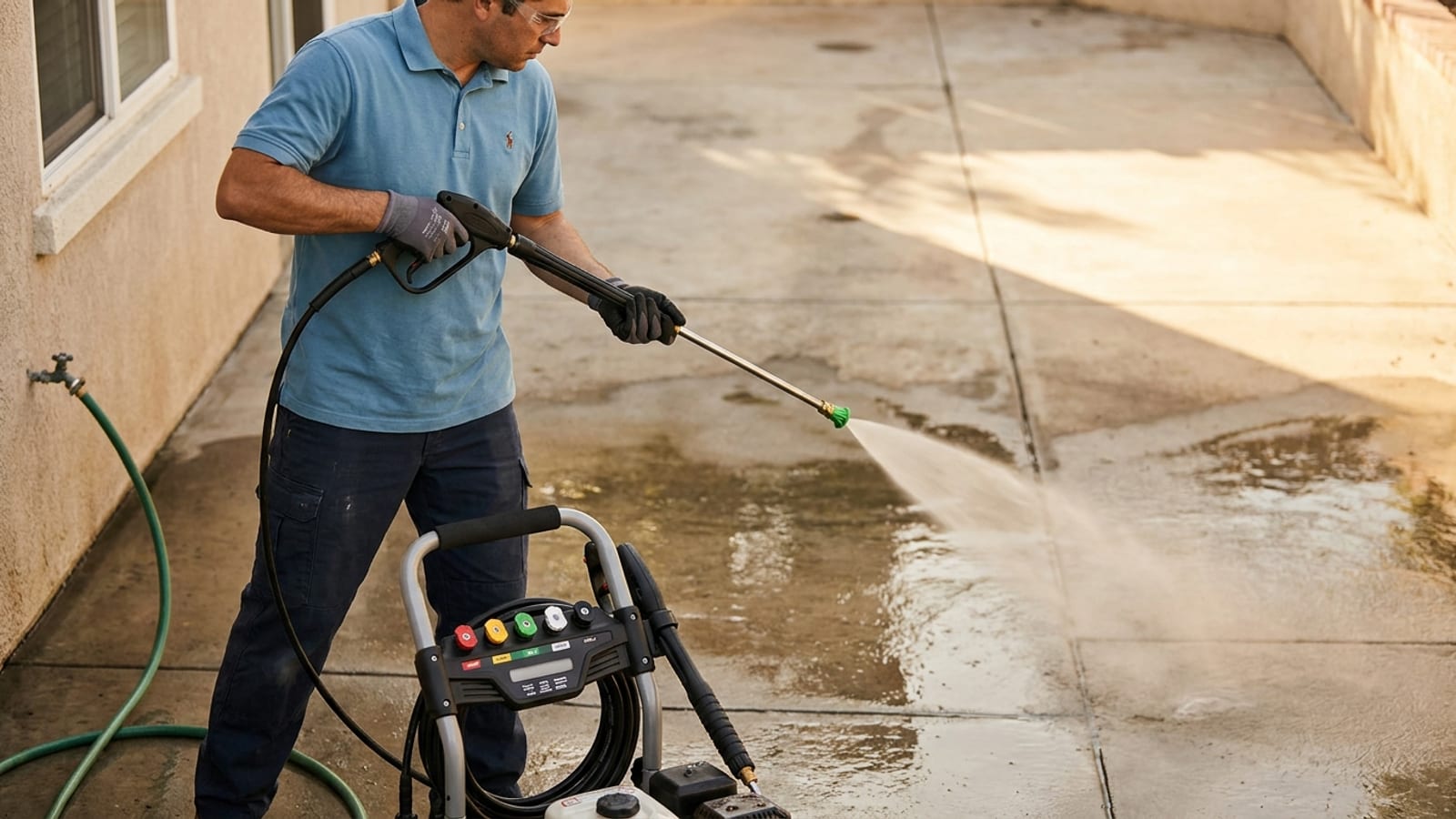
- The nozzle tip you pick matters more than the machine’s PSI. Red 0-degree tips etch concrete and can seriously injure skin. Green 25-degree tips handle most residential jobs.
- GPM (flow rate) does more cleaning work than PSI on most surfaces. A 4 GPM unit at 3,000 PSI outperforms a 1.5 GPM unit at the same pressure.
- Concrete and hard flatwork can handle high pressure with a surface cleaner. Siding, stucco, wood, painted surfaces, and roofs need soft wash low pressure only.
- Start 18 inches from the surface, keep moving, work top-down. Never hold the wand still. That’s how you etch concrete and blow holes in siding.
A pressure washer at full throttle can strip paint in under a second, etch concrete, blast the glaze off roof tiles, and cut skin. It can also clean a decade of grime off a driveway in 45 minutes without scratching the surface. The difference is knowing which tip to use, what pressure fits the surface, and how to move the wand. This guide covers all of it.
If you’re renting from Home Depot, you’re probably getting a 2,500 to 3,200 PSI gas unit. That’s a capable machine. Plenty of power to do real damage to the wrong surface. Here’s how to use it right.
Understanding PSI and GPM
Most people focus on PSI (pounds per square inch) when shopping for or renting a pressure washer. PSI tells you how hard the water hits. But GPM (gallons per minute) tells you how much water flows, and GPM is what actually rinses debris off the surface.
A unit pushing 2,000 PSI at 4 GPM will out-clean a unit running 3,500 PSI at 1.2 GPM on most residential surfaces. The higher-flow machine simply moves more grime per second. This is why cheap electric pressure washers often disappoint: they have decent PSI on paper but very low GPM, so they push grime around more than they remove it.
For context, consumer electric pressure washers typically run 1.2 to 1.8 GPM. Consumer gas units run 2.0 to 3.0 GPM. Professional rigs run 3.5 to 5.5 GPM. For a full residential exterior, you want at least 2.5 GPM.
The color-coded nozzle tips
Every pressure washer has interchangeable nozzle tips color-coded by the spray angle they produce. The angle determines how concentrated the pressure is. Narrow angle, more concentrated, more aggressive. Wide angle, softer.
Red, 0 degrees. A single point-stream with all PSI concentrated in one spot. Do not use this on painted surfaces, wood, vinyl siding, or decorative concrete. It will etch plain concrete in seconds. It can cut skin at close range. The only legitimate uses are very targeted gum removal from hard concrete or spot-blasting rust in a controlled situation, and most professionals rarely touch it. If you’re renting for a house wash or driveway, leave the red tip in the bag.
Yellow, 15 degrees. A narrow fan. Used for stripping paint, removing stubborn buildup on hard concrete, or chiseling out heavy caked-on dirt. Still very aggressive. Keep it moving at all times, never hold in one spot.
Green, 25 degrees. The general-purpose tip. Handles most residential concrete cleaning, rinsing off detergents, and cleaning hard outdoor furniture. A good default for flatwork where you don’t have a surface cleaner attachment.
White, 40 degrees. A wide, gentle fan. Best for softer surfaces: cars, wood fences, vinyl siding when you have no other option, pre-wetting areas before applying detergent. Low enough pressure to be reasonably safe on painted surfaces, though soft washing is still a better approach.
Black, low pressure (sometimes labeled “soap”). This tip has a much wider orifice that dramatically drops the output pressure. It’s designed for drawing up and applying detergent via a downstream injector. It also works for very delicate rinsing. Not a cleaning tip on its own.
PSI by surface: what can handle what
This is where most DIY pressure washer damage happens. High PSI is not universal. Different surfaces have very different tolerances.
Concrete and masonry flatwork. The most forgiving surface. A green 25-degree tip or, better, a round surface cleaner attachment can safely run 2,500 to 3,500 PSI on plain concrete driveways, walkways, patios, and masonry. The surface is hard enough to take the pressure. See concrete cleaning for the full process including pre-treating with chemistry before pressure.
Pavers and brick. Moderate pressure with a surface cleaner. The concern isn’t the paver surface, it’s the polymeric sand or mortar in the joints. High pressure aimed directly into joints blows the sand out and creates gaps. Use a surface cleaner to keep the pressure distributed. Re-sand with Alliance Gator or SEK polymeric sand after cleaning.
Composite and pressure-treated wood decks. Use a white 40-degree tip at 1,200 to 1,500 PSI maximum. Soft rotted wood, old weathered deck boards, and painted wood get soft washing instead, not high pressure. High pressure on soft wood raises the grain and creates a rough, splintery surface that’s harder to seal or stain afterward. Deck and patio cleaning usually means a combination of low-pressure wash and soft-wash chemistry.
Vinyl siding. Technically pressure-washable at low settings, but soft washing is the correct answer. Vinyl siding seams and overlaps are not sealed tight. High pressure driven upward into those seams forces water behind the siding, into the sheathing and insulation. Always spray downward on siding, never upward. A white 40-degree tip at arm’s length is the minimum safety margin. A soft wash at under 100 PSI with sodium hypochlorite chemistry is better. See house washing for why soft washing outperforms pressure on any exterior.
Stucco. Soft wash only. Stucco has a textured finish that high pressure will erode. Hairline cracks in older stucco become real cracks. Pressure also drives water into those cracks and into the wall cavity. Many San Diego coastal homes have decades-old stucco that looks solid until a pressure washer opens it up. Low pressure, soft-wash chemistry, done.
Roofs. Never pressure wash a roof. Not with any tip. Not at any distance. Tile roofs, composition shingles, and clay tile all have surfaces that high pressure damages or dislodges. Gloeocapsa magma algae (the black streaks on roofs throughout San Diego County, especially coastal cities like Encinitas, Carlsbad, and La Jolla) is killed with sodium hypochlorite and surfactant at low pressure, allowed to dwell and rinse with rain. That’s soft washing. Roof cleaning is one service where DIY with a rental unit is genuinely dangerous, both to the roof and to you on a ladder holding a pressurized wand.
Painted wood or old wood. Avoid high pressure entirely. You will strip the paint and raise the wood grain. Soft wash or garden hose with detergent.
Windows. A 40-degree tip from a distance can rinse windows, but direct pressure against window glass edges, old glazing, and frames loosens seals and caulking. Most window cleaning doesn’t require a pressure washer at all.
AC fins, electrical panels, exterior outlets. Do not pressure wash these. Water forced into an electrical panel is a serious hazard. AC condenser fins bend permanently under direct pressure and reduce unit efficiency.
Your car’s clear coat. Not with a zero or 15-degree tip at close range. A 40-degree tip from 18 inches is fine for rinsing, but car paint is softer than most people assume.
Technique: how to hold and move the wand
The biggest mistake is standing too close and holding still. Both guarantee damage or uneven results.
Start 18 inches back. When you first hit a surface with a new tip or new area, start at 18 inches from the surface and assess. You can always move closer. You can’t un-etch a stripe you already cut.
Keep the wand moving. Every second you hold the wand still in one spot, you’re concentrating pressure in one place. On concrete, that means a lighter circle in the center of your stopping point. On wood or painted surfaces, it can mean a hole. Consistent motion at consistent speed is what produces even results.
Consistent angle. Hold the wand at 45 degrees to the surface for cleaning. Perpendicular (90 degrees, straight down) wastes pressure and creates more splash-back. Angling slightly forward helps the water carry debris in the direction you’re moving.
Work top-down on vertical surfaces. On a house, fence, or retaining wall, start at the top and work down. Dirty water running down over already-cleaned areas is much easier to re-rinse than cleaning an area twice because dirty water from above contaminated a clean section.
Even, overlapping passes. Overlap each pass by about 20 percent, the same technique you’d use painting. Random passes leave inconsistent cleaning. Systematic rows leave even results.
The single biggest upgrade: the surface cleaner
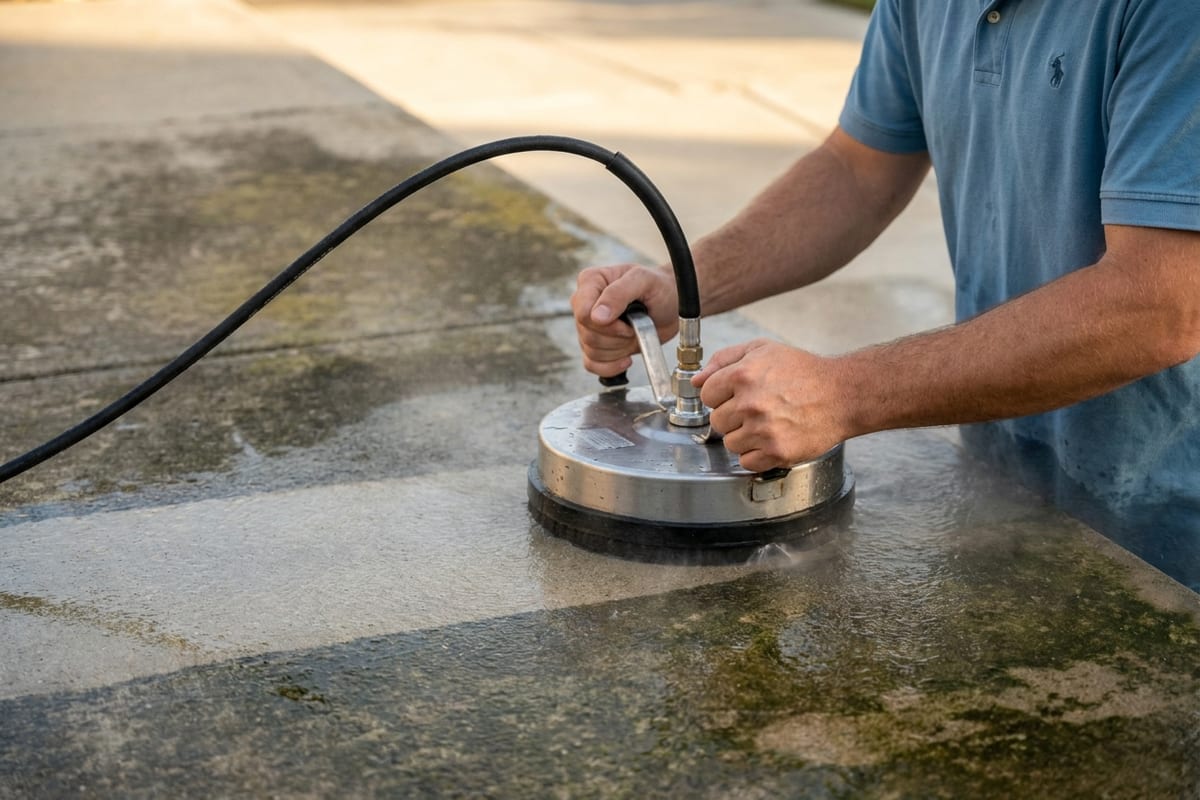
If you’re cleaning a driveway, sidewalk, patio, or any horizontal flatwork larger than about 100 square feet, rent or buy a round surface cleaner attachment. A consumer 15-inch unit runs about $90 at big-box stores. A professional 20-inch unit is $250.
The surface cleaner has two spinning nozzle arms inside a shroud. It connects between the wand and your trigger gun. The spinning distributes pressure evenly in a circle, with no stripe overlap pattern. The shroud contains overspray. The result is stripe-free concrete at three to four times the speed of a bare wand.
Using a bare wand on a driveway is the most common pressure washing mistake homeowners make. You’ll almost certainly leave wand stripes, lighter or darker areas in the fan-tip’s overlap pattern. They’re permanent until the entire surface is re-cleaned with a surface cleaner. Don’t skip this tool.
Detergent and downstream injectors
Pressure alone removes loose dirt. Stuck-on grime, mildew, algae, and staining respond to chemistry.
Most gas pressure washers have a downstream injector port. This pulls liquid detergent from an external bottle and injects it into the water stream after it passes the pump, using the low pressure of the siphon effect. It works only when you have the black low-pressure soap tip installed. Swap to a higher-pressure tip and the injector stops drawing.
For house washing, a sodium hypochlorite and surfactant mix (called a soft wash mix) handles mildew, algae, and oxidation. A 1 to 3 percent sodium hypochlorite solution with a biodegradable surfactant like Spray and Forget or a dedicated SH booster covers most residential exteriors.
Apply detergent at low pressure. Let it dwell 5 to 10 minutes. Don’t let it dry. Rinse at the appropriate pressure for the surface. That dwell time is what lets the chemistry do the work so you don’t have to force it off with high pressure.
Safety
A pressure washer is not a toy. The hazards are real and underappreciated.
Never point it at people or pets. A 3,000 PSI stream will cut skin at close range. Eye injuries from reflected debris are common. Safety glasses are required.
Kickback. Gas pressure washers have significant kickback when you squeeze the trigger. Two hands on the gun, feet planted. Never operate one-handed.
Ladders plus wands are dangerous. The kickback from a pressure washer wand can knock you off a ladder. Professionals who work at height use extension wands from the ground. If you’re thinking about getting on a roof or a second-story ladder with a running wand, stop. This is when to call a pro.
Electrical outlets and meters. Water and electricity. Give them wide clearance. If you’re cleaning near an exterior outlet, the outlet should be GFCI-protected. If you’re not sure it is, don’t spray it.
Water inlet pressure. Always connect a pressure washer to a water source with adequate flow before starting the engine. Running the pump dry for more than a few seconds damages the pump.
What not to pressure wash
To repeat and add to the surface guidance above: roofs, painted old wood, any exterior wood with visible rot, stucco, windows, electrical, AC units, lap siding with upward spraying, car paint with a narrow tip, and any surface showing signs of prior pressure damage.
For reference on what soft washing covers versus what pressure washing covers, the full comparison is in pressure washing vs. power washing vs. soft washing.
When to call a pro
DIY pressure washing makes sense for small concrete areas, a single-car driveway, or a concrete patio you’re confident about. It stops making sense when:
- The job involves the roof, siding, stucco, or any surface where the wrong technique causes permanent damage
- You’re dealing with rust staining, oil stains, or efflorescence that needs specific chemistry (F9 Barc, oxalic acid, EBC)
- The area is large enough that a full Saturday still leaves you with patchy results
- You’re thinking about getting on a ladder with a running wand
- You want the work to look professional, with even, stripe-free results
Professional equipment, specifically hot-water rigs, commercial-grade downstream injectors, and surface cleaners in the 20-inch-plus range, plus the chemistry knowledge behind them, produce results that rental equipment simply can’t match. A full house wash for a typical San Diego home runs $200 to $450. A driveway runs $180 to $400. Both are done in under two hours by a crew that won’t leave wand stripes or damage the surface.
Rinse Pro SD serves all of San Diego County, from Oceanside and Carlsbad down through Chula Vista and Imperial Beach, inland to El Cajon, Poway, Escondido, and Alpine.
Call (858) 925-5546 or request a quote online. Upfront pricing, fast response, no surprises.