TL;DR
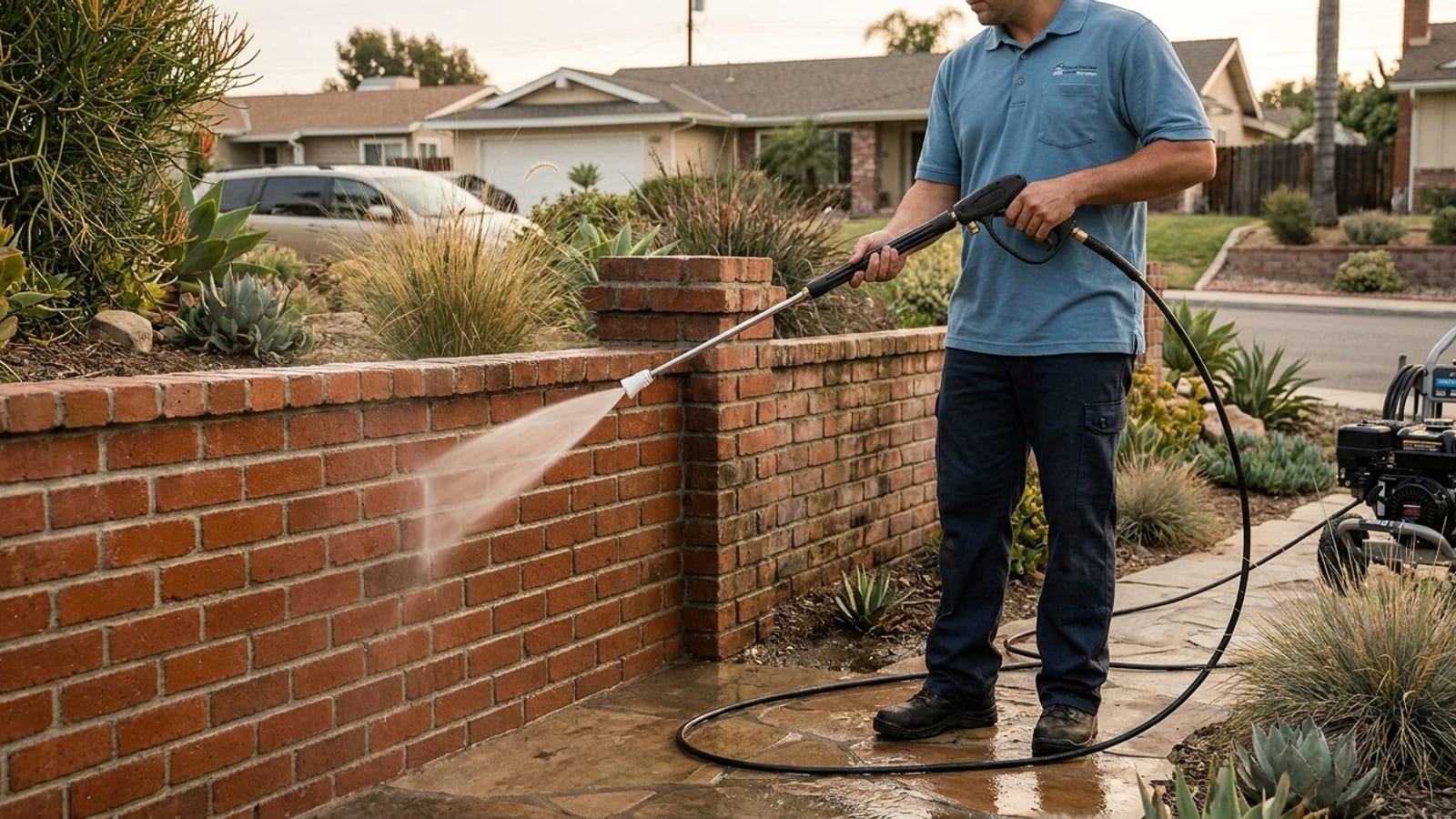
- Pressure is the enemy of brick. Keep it at 500 to 1,200 PSI max, use a 40-degree white tip, and stay at least 12 inches from the surface.
- Efflorescence (the white powdery bloom on mortar joints) needs a dry brush first and a masonry-specific cleaner second, not a pressure washer.
- Moss and algae on shaded San Diego brick respond well to a soft-wash mix of sodium hypochlorite plus surfactant, low pressure to rinse.
- Old brick with lime mortar is the most fragile material on a property. If the house was built before 1950, call a pro before touching it with a wand.
Most people overestimate how tough brick is. It looks solid. It looks like it could handle anything. Then they point a 3,000 PSI wand at it, and within two passes the outer fired skin is spalling off in flakes and the mortar joints are starting to erode. Brick is durable under compression. It’s not durable under a direct high-pressure water blast at close range. The good news is that cleaning brick well isn’t complicated, it just requires lower pressure and the right chemistry.
Here’s the full method, from prepping the surface to knowing when to seal it afterward.
Why pressure is the real risk
Brick is fired clay, which means it has a dense, hard outer shell and a more porous interior. The outer shell is what gives brick its weather resistance. Once you blast through it, the exposed interior absorbs water and stains faster, is more vulnerable to freeze-thaw cycles, and looks chalky even after it dries. That damage is permanent. You can’t un-spall a brick.
Mortar joints are even more vulnerable. Standard Portland cement mortar can handle moderate pressure, but older homes in Encinitas, North Park, and other established San Diego neighborhoods often have lime mortar. Lime mortar is intentionally soft and flexible. It’s designed to be the sacrificial element that absorbs movement and moisture instead of cracking the bricks themselves. High-pressure cleaning strips it out, and repointing a wall or chimney runs $500 to $2,000 or more depending on how much damage there is.
The rule: for brick, you’re cleaning with chemistry, not pressure.
Old brick vs new brick
New brick (built after about 1970) was typically laid with Portland cement mortar and fired at higher temperatures. It’s more uniform and more pressure-tolerant, though you still want to keep PSI under 1,200 and the tip at 40 degrees.
Old brick is a different situation. Homes built before 1950 in San Diego, especially Craftsman and Spanish Colonial revival styles, almost always used lime or lime-Portland blend mortar. These joints are softer and more water-absorbent. If the mortar looks sandy, crumbles easily when you press on it, or has visible gaps where joints have already eroded, treat the entire surface like it’s made of glass.
Antique or recycled brick is even more fragile. It was often under-fired by modern standards, which means the hard outer shell is thinner or inconsistent. If you’re not sure what you have, test an inconspicuous section at 500 PSI from 18 inches away. If any grit or surface material comes off, that’s your ceiling. Stop there.
What you need before you start
Pressure washer setting. For brick, you want 500 to 1,200 PSI. If your machine only goes down to 1,500, reduce your tip angle and increase your distance. Don’t fight the setting with brute-force distance.
Nozzle tip. White 40-degree tip only. Never yellow 15-degree, never green 25-degree on mortar joints, and absolutely never the red zero-degree tip anywhere near masonry. The wide fan distributes pressure evenly and keeps you out of trouble.
Pump-up sprayer. For applying cleaners before you rinse. A 2-gallon plastic sprayer is fine. This is how you do the actual cleaning work, with chemistry that soaks and lifts the grime, not with pressure that forces it off.
Stiff natural-bristle brush. For scrubbing and for dry-brushing efflorescence before you wet the surface.
Appropriate cleaner. General dirt and algae: sodium hypochlorite plus a surfactant at around 1 percent dilution. Efflorescence: a dedicated masonry efflorescence cleaner (Sure Klean 600 Detergent, PROSOCO products, or equivalent). Never a bleach-acid mix, those two react and release dangerous chlorine gas.
Garden hose or low-pressure rinse. For rinsing chemistry off the surface when pressure washing isn’t needed.
Step-by-step: how to clean brick
1. Pre-wet the brick and surrounding areas
Soak the brick surface with plain water before applying any cleaner. Wet brick won’t absorb the cleaning chemistry as fast, which gives you more control over dwell time and reduces the risk of bleach or acid solutions penetrating deep into the masonry. Pre-wet any nearby plants, wooden trim, metal fixtures, and painted surfaces. Sodium hypochlorite will bleach painted surfaces and oxidize metal if it sits.
2. Apply your cleaner and let it dwell
For general dirt, organic staining, and algae: mix sodium hypochlorite (12.5% pool shock or professional SH) at about 1 part SH to 10 parts water plus a surfactant. Apply from a pump-up sprayer, top to bottom, and let it dwell for 5 to 10 minutes. Don’t let it dry on the surface, mist with plain water if it starts to flash off in the San Diego sun.
For heavy biological growth or moss: a slightly stronger mix, up to 3 percent SH, is reasonable. The goal is to kill the root structure, not just clean the surface.
You’ll see the staining lighten as the chemistry works. That’s exactly what you want.
3. Rinse, low and slow
Rinse the surface from top to bottom, white 40-degree tip, held 12 to 18 inches from the surface. Use smooth, even strokes and keep moving. Never hold the tip in one place. The goal is to flush the chemistry and lifted grime off the surface, not to blast anything.
Work top to bottom so dirty rinse water doesn’t re-soil areas you’ve already cleaned.
If the brick is particularly delicate, use a garden hose with a spray nozzle for the rinse. It takes longer but there’s no risk of pressure damage.
Efflorescence: the white bloom that pressure washing makes worse
Efflorescence is the white, powdery mineral deposit that appears on brick and mortar joints. It’s caused by soluble salts migrating through masonry and depositing on the surface as water evaporates. You see it a lot on San Diego coastal properties, where salt air works into mortar, and on walls with minor water intrusion issues.
The instinct is to pressure wash it off. That’s the wrong move. Wetting the surface pushes more moisture through the masonry, which can draw additional salts to the surface after it dries. You end up with the same deposit back within a few weeks, sometimes worse.
The right sequence:
Dry brush first. Use a stiff natural-bristle brush (not wire, which can leave metal deposits) to dry-brush as much of the efflorescence off as possible before wetting anything. This removes the surface bloom without activating what’s still inside the masonry.
Apply a masonry efflorescence cleaner. Products like Sure Klean 600 Detergent or PROSOCO’s Sure Klean 100 are dilute acid-based formulas designed for masonry. Follow label dilutions. Apply to wet brick, scrub with a brush, and rinse thoroughly. For light efflorescence, a dilute white vinegar solution (1 part vinegar to 5 parts water) can work as a gentler option.
Address the moisture source. If efflorescence keeps coming back, there’s ongoing water intrusion. That’s a waterproofing issue, not a cleaning issue. A breathable masonry sealer can help slow it down, but it won’t solve the underlying problem on its own.
Moss and algae on shaded San Diego brick
North-facing walls, shaded courtyards, and brick near irrigation heads in communities like Carlsbad and Oceanside tend to collect a persistent layer of green or black biological growth. The marine layer and moisture keep shaded surfaces damp enough for algae and moss to root.
Soft washing is the method here. The same sodium hypochlorite plus surfactant mix that works on house washing and roofs works on brick. Apply with a pump-up sprayer, let it dwell long enough for the biology to die (10 to 15 minutes for heavy growth), and rinse at low pressure.
The key with moss specifically: if the root system has worked into the mortar joints, you may need two treatments a few days apart. Kill the visible growth, let it dry and die fully, then come back for a second application and a final rinse. Rinsing live moss can sometimes push roots deeper rather than removing them.
For thick biological crusts on shaded brick or on brick retaining walls, a soft-wash approach combined with a follow-up algaecide treatment gives the most durable result.
Protecting mortar joints
The joints are the most vulnerable part of any brick surface. Keep these rules in mind:
Never use a zero-degree or 15-degree tip anywhere near a mortar joint. Ever.
Hold the 40-degree tip at an angle that directs water flow parallel to the joint, not perpendicular into it. When you’re rinsing, aim with the joint, not across it.
If a joint already shows erosion or gaps, cleaning it will make the damage more visible and potentially worsen it. Seal or repoint first, then clean.
After cleaning, inspect every joint. If you see sandy material in the rinse water or visible erosion in the joints, stop and assess before continuing.
Sealing brick after cleaning
Sealing isn’t mandatory, but it can extend the time between cleanings and reduce efflorescence recurrence. The important word is breathable. Brick needs to breathe; moisture vapor has to be able to escape through the surface. A film-forming sealer traps moisture, which causes spalling in freeze-thaw climates and can cause surface blistering even in San Diego’s mild climate.
Look for a penetrating silane-siloxane water repellent, products like Masonry Defender, RadonSeal, or equivalent professional formulas. These work below the surface to repel water without blocking vapor movement.
Apply only to fully clean, fully dry brick. In San Diego, that means waiting at least 48 hours after cleaning, longer during June Gloom when ambient humidity stays elevated and brick dries slowly.
Be aware of the tradeoff: a good sealer will slightly darken brick color and can slightly change the surface texture. Test on an inconspicuous section before committing to the whole wall.
When to call a pro
Some brick and masonry situations are worth handing off.
Historic or pre-1940 brick. If you have lime mortar and aren’t certain of its condition, don’t risk it. A professional with experience on historic masonry can assess the joints and choose appropriate chemistry and pressure for what’s actually there.
Large exterior walls or chimneys. A single-story driveway border is a manageable DIY job. A full two-story exterior wall or a chimney requires staging or scaffolding, proper water containment, and a different level of risk if something goes wrong.
Staining you can’t identify. Rust and mineral staining on brick often looks similar but requires completely different chemistry. Rust and oil stain removal on masonry involves oxalic acid-based products (F9 Barc) that need to be handled carefully and rinsed thoroughly. Applying the wrong product can permanently alter the brick color.
Post-construction residue. Mortar smears, grout haze, and concrete spatter on brick from recent work require dilute muriatic acid or professional-grade masonry cleaner. This is not a DIY job unless you have experience with acid safety.
If you’re in San Diego County and want a professional assessment, our concrete cleaning and masonry services cover brick walls, planters, walkways, retaining walls, and more. We can look at your surface and tell you honestly what the right approach is before any work starts.
Get a quote from Rinse Pro SD
Brick and masonry cleaning done right runs $150 to $450 for most residential projects in San Diego, depending on surface area, staining, and whether sealing is included. The job takes longer than concrete because lower pressure and careful chemistry application require more time per square foot.
Call (858) 925-5546 or request a quote online. Upfront pricing, no surprises. We serve all of San Diego County, from Oceanside and Carlsbad down to Chula Vista and Otay Ranch, and inland to El Cajon, Santee, and Escondido.