TL;DR
- Stucco is porous and brittle. High pressure gouges it, opens hairline cracks, and drives water into the wall. Soft wash only.
- The right mix is sodium hypochlorite plus surfactant, applied at low pressure with a downstream injector or dual-lance wand, then rinsed gently.
- Acrylic and synthetic stucco finishes need a weaker solution and a spot test first. Color-coat stucco can strip if you go too strong.
- Most San Diego stucco needs cleaning every one to two years. Coastal homes on the north county or OB side often need it closer to every 12 months.
Drive through any neighborhood in Encinitas, Carlsbad, Chula Vista, or Poway and almost every house you pass has stucco on it. It’s the default exterior surface in San Diego County, and for good reason. It handles the climate, it takes color well, and it’s cheap to install. The downside: stucco is porous. It soaks up organic matter, holds moisture longer than brick or wood, and grows algae on the shaded or coastal side like it’s trying to become a reef.
The mistake homeowners make, and the mistake some pressure washing crews make, is treating it like concrete. Stucco is not concrete. A flat concrete driveway can handle 3,000 PSI and a surface cleaner. Stucco at that same pressure gouges the texture, blasts out the binder material, and if there are any hairline cracks, it forces water into the wall cavity behind the finish coat. Cleaning stucco means using chemistry instead of brute force.
What you’re actually cleaning off
San Diego stucco picks up a pretty consistent set of problems depending on where the house sits.
Gloeocapsa magma algae and mildew. This is the dark green to black streaking that runs down north-facing and west-facing walls, especially near the coast. It’s not dirt. It’s a living organism that roots into porous surfaces. A garden hose and a scrub brush won’t touch it. The bleach in a sodium hypochlorite solution is what kills it at the root level so it doesn’t come back in three months.
Cobwebs and dirt-dauber nests. Stucco texture is ideal nesting territory. Eave lines and corners collect these fast, especially in summer.
Sprinkler overspray staining. The base of most stucco walls in neighborhoods with landscape irrigation shows a rust-brown to white mineral haze. That’s calcium and iron deposits from the water. It’s a different problem from algae and needs a different chemistry approach, often an oxalic-acid or F9 Barc rinse on the affected area.
Salt film near the coast. La Jolla, Pacific Beach, Oceanside, Del Mar. Homes within about a mile of the water develop a fine salt residue on the surface that accelerates algae growth and can, over time, work into the finish coat. Regular soft washing removes it before it builds up.
Why pressure washing damages stucco
Stucco is typically a three-coat system: a scratch coat, a brown coat, and a finish coat. The finish coat is usually 1/8 to 3/16 of an inch thick. That’s thin. A yellow 15-degree tip at 2,500 PSI held close enough to clean algae off a textured surface will absolutely chip and gouge that finish coat. Once the finish coat is compromised, you have a moisture intrusion problem, not just a cosmetic one.
Hairline cracks are everywhere on older San Diego stucco. They’re normal. The stucco expands and contracts with temperature, and over time fine cracks develop. If you jam a fan tip into one of those cracks from a foot away, you’re not cleaning it. You’re turning a hairline crack into a gap that holds water. That water works into the brown coat, grows mold behind the finish, and eventually shows up as a bubbling or delaminating section of wall. That repair costs a lot more than a cleaning.
The rule for stucco is simple: the lower the pressure, the safer the finish. Under 500 PSI on the surface is the professional target for soft washing. The chemistry does the cleaning. The water does the rinsing.
The soft wash method, step by step
This is the same method we use at Rinse Pro SD on house washing jobs throughout the county. If you’re DIYing it, follow this sequence exactly.
1. Pre-wet everything nearby
Before any chemistry goes on the wall, soak down all the landscape, potted plants, furniture, and any adjacent surfaces within 10 feet. Sodium hypochlorite will burn leaves. It’ll also discolor composite deck boards if it sits. Pre-wetting slows absorption and gives you time to rinse before damage sets in.
2. Mix your soft wash solution
The standard residential soft wash mix for stucco is 1 to 3 percent sodium hypochlorite at the surface. If you’re diluting 12.5 percent pool shock, that’s roughly 1 part bleach to 3 to 4 parts water, plus a capful of surfactant (Elemonator is the industry standard; dish soap works in a pinch but leaves residue).
The surfactant matters. It thickens the solution so it clings to the vertical surface instead of running off before the dwell time does anything.
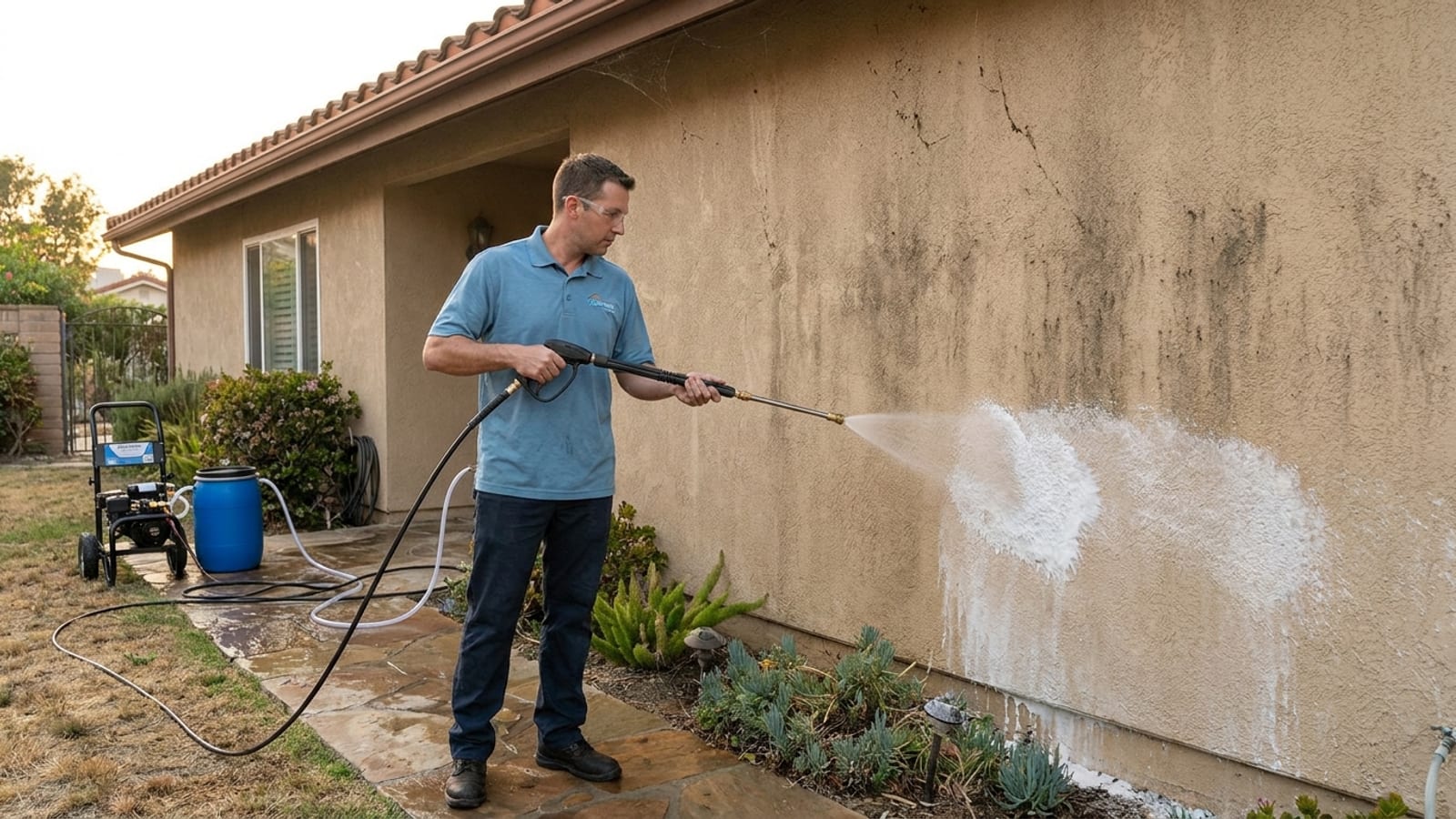
For a two-story house, most contractors use a 12-volt soft wash system with a dedicated pump and low-pressure chemical hose. For DIY, a pump-up garden sprayer or a downstream injector on a 4 GPM machine set to its lowest-pressure nozzle (a 40-degree white tip from 8 feet out) will work.
3. Apply top to bottom, let it dwell
Apply the solution from the top of the wall down, working in sections. This prevents dirty runoff from re-contaminating areas you’ve already treated. Watch what happens as it dwells. Algae and mildew will visibly lighten and start turning from green-black to a grayish-brown as the bleach chemistry works. That color shift is how you know the biology is dying, not just being pushed around.
Dwell time is 5 to 15 minutes depending on how heavy the growth is. Don’t let it dry on the surface. If it starts to flash off in direct sun, mist the area lightly to keep it wet.
4. Rinse gently, top to bottom
Use a 40-degree white tip (the widest, lowest-impact nozzle) held at least 18 to 24 inches from the surface. Work from the top down and keep the water moving. No holding the nozzle still. No aiming directly at hairline cracks or expansion joints. Let the volume of water flush the dead organic matter off, not the pressure.
Rinse any landscaping and hardscape at the base of the wall thoroughly when you’re done.
5. Second pass for heavy buildup
If the north side of the house has been neglected for three or four years, one application may not be enough. Let the surface dry for a day, evaluate, and repeat the chemistry application. Two light passes are safer and more effective than one heavy application at higher concentration.
Acrylic and synthetic stucco: use a weaker mix
Traditional Portland-cement stucco is what most older San Diego homes have. But from the 1990s onward, a lot of houses in Carlsbad, Poway, and Chula Vista were built with acrylic or EIFS (exterior insulation and finish system) stucco. It looks similar to the outside eye but behaves differently when cleaned.
Acrylic finishes are softer, more flexible, and more sensitive to bleach. A 3 percent sodium hypochlorite mix that’s fine on a 1970s cement-stucco bungalow in El Cajon can lift or discolor the pigment on a color-coat acrylic finish on a 2004 house in Rancho Bernardo.
Before you apply anything to acrylic or synthetic stucco, do a spot test in an inconspicuous area. Mix a 0.5 to 1 percent solution (much weaker), apply it, dwell 5 minutes, rinse, and check for color change. If it looks fine after 30 minutes, you can proceed. If there’s any discoloration, stop and call a pro who has experience with that finish type.
The same caution applies to painted or elastomeric-coated stucco. Elastomeric coatings are thick rubber-like paint systems used to seal cracked stucco. They’re common on older Escondido and Alpine homes. Bleach at full residential strength can haze or dull the surface. Soft wash works, but it needs to be dialed back to 1 percent or below.
Sprinkler staining at the base: a separate fix
If the base of your stucco wall has brown or orange-rust staining from sprinkler overspray, sodium hypochlorite won’t touch it. That staining is mineral deposit, not biological growth. It needs oxalic acid or F9 Barc applied carefully to the affected area, a 5-minute dwell, and a neutral rinse.
Apply F9 with a brush or a low-pressure sprayer aimed at the stained section only. Keep it off any landscaping. Rinse very well because oxalic acid, if it dries, leaves a white haze of its own. See rust and oil stain removal for the full explanation of how those stains work.
Hairline cracks: what to do (and what not to do)
If you find hairline cracks in the stucco before cleaning, don’t ignore them and don’t try to clean them out with a pressure tip. Soft wash over them the same way you’d treat any other surface. After the wall is cleaned and fully dry, inspect the cracks. Hairlines under 1/16 inch wide are cosmetic and can be filled with a stucco patch caulk or a matching elastomeric paint. Anything wider, or any crack you can feel a slight separation in, should be looked at by a stucco contractor before the next time water gets near that wall.
Cleaning does not cause cracks. Cleaning reveals them. That’s actually useful. Once the algae and dirt are gone, you get a clear picture of the wall’s actual condition.
How often San Diego stucco needs cleaning
Most San Diego homes need stucco cleaned every one to two years. That’s a wide range because the variables are significant.
Coastal homes in Oceanside, Del Mar, Encinitas, and La Jolla get marine-layer mildew and salt film on a cycle. The marine layer deposits moisture on north and west-facing walls almost every morning from May through September. Those homes often need a soft wash every 12 to 18 months to keep the algae from establishing. Read more about how the coast affects exterior surfaces in our house washing guide.
Inland homes in El Cajon, Santee, Escondido, and Alpine deal more with dust accumulation and sprinkler staining than with marine mildew. Those walls stay cleaner longer, and 18 to 24 months between cleanings is realistic.
The reliable indicator is the north-facing wall. If it’s noticeably darker than the south-facing wall, there’s active algae growth that won’t resolve on its own.
When to call a pro
DIY soft washing is doable on a single-story home if you’re methodical about it. Call a professional for these situations:
Two-story homes. Reaching the upper eaves and gable ends safely requires a proper ladder setup or a 24-foot extension wand. One slip on a ladder while running a spray gun is a serious situation.
Heavy algae that’s been building for years. If the wall hasn’t been washed in five or more years, the algae may have worked into the finish coat. A professional can assess whether the surface needs a treatment plan beyond standard soft washing.
Painted or elastomeric-coated stucco. The risk of discoloring or damaging specialty coatings is high enough that it’s worth paying for someone who’s done it hundreds of times.
Any sign of delamination or bubbling. If sections of the stucco look like they might be separating from the wall, cleaning the surface before that’s addressed will cause more damage.
Our house washing service covers everything from a standard soft wash to two-story homes with specialty finishes. We serve the full San Diego County footprint, from coastal homes in Oceanside and La Jolla to inland properties in Alpine, Poway, and Escondido.
Ready to get your stucco cleaned?
Call (858) 925-5546 or request a quote online. We give upfront pricing before any work starts, show up on time, and clean without damaging the finish. Serving all of San Diego County.