TL;DR
- Moss is different from black algae streaks. This post covers moss specifically, the thick green growth that lifts shingle edges and holds moisture against the roof.
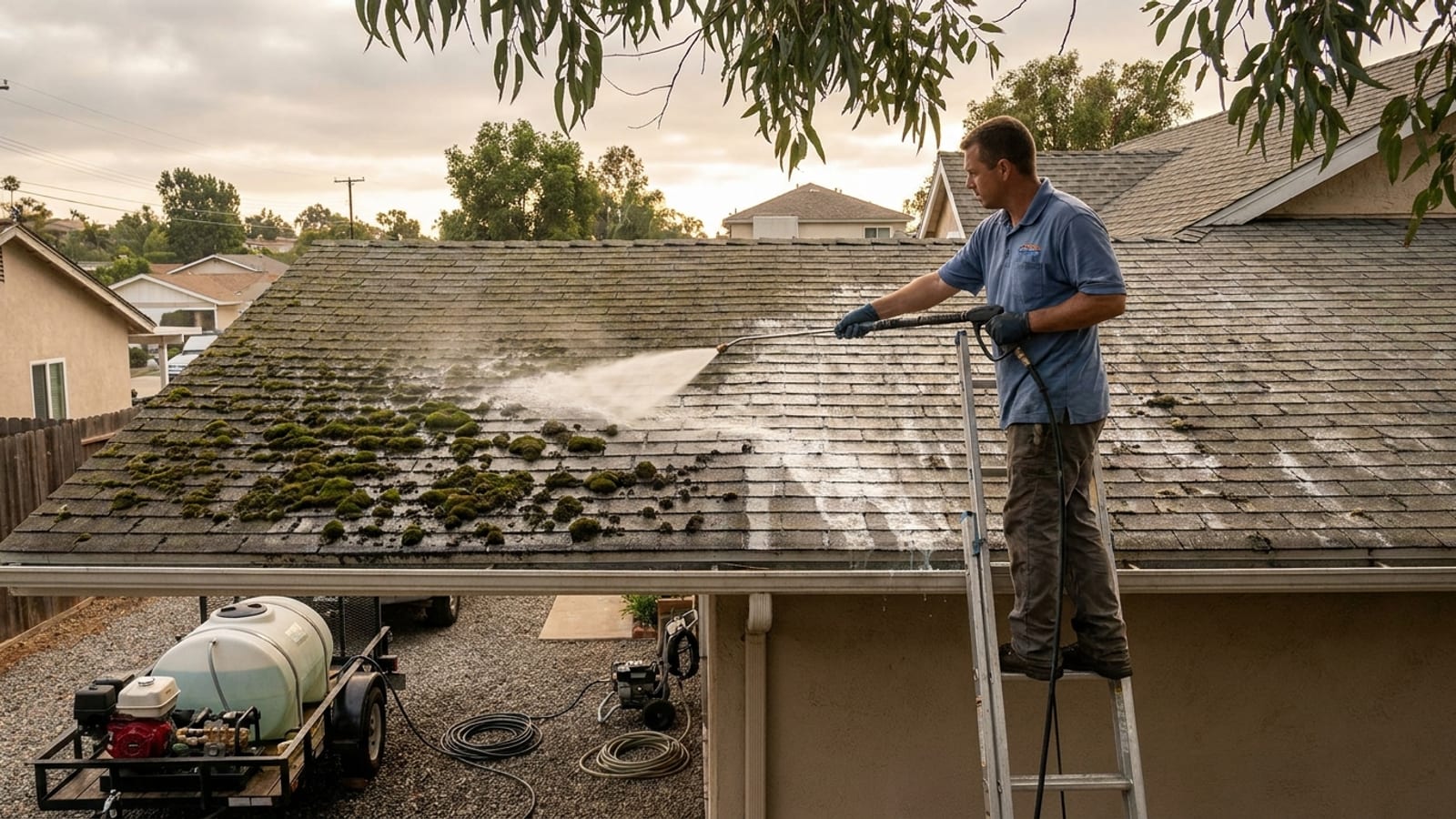
- The only safe removal method is soft washing: a sodium hypochlorite plus surfactant solution applied at low pressure, allowed to dwell, then rinsed gently. Never scrape aggressively and never point a pressure washer at shingles.
- Most asphalt shingle manufacturers void the warranty if you pressure wash. The granules those shingles depend on are not reattachable.
- Prevention is simple: zinc or copper strips at the ridge, trimmed branches, and clean gutters. Fix the shade problem and the moss stops coming back.
Moss on a roof looks like a landscaping problem. It’s not. It’s a structural one. Moss holds water against shingles the way a soaked sponge holds water against wood: steadily, constantly, and invisibly until the damage is already done. Left alone long enough, it lifts shingle edges, works under the tabs, and gives water a direct path to the decking. In San Diego, this happens faster than most people expect, especially on north-facing roofs in coastal canyons and on homes shaded by eucalyptus or mature oaks.
Here’s what’s actually happening and how to fix it without causing more damage in the process.
Moss vs. black streaks: know what you’re dealing with
These two get confused all the time, but they’re completely different organisms that need different approaches.
Moss is a plant. It forms thick, spongy green or greenish-brown mats along shaded roof sections, especially at the lower edge, near the fascia, and around any area that stays damp longest. Run your hand across it and it feels like a wet doormat. Moss physically grips the shingle surface, and as it grows, it pushes up under the shingle tab edges. That’s the mechanical damage. Water then pools in those lifted gaps instead of shedding off cleanly.
Black streaks are a different organism entirely. Gloeocapsa magma is a type of algae that forms flat, dark streaks or stains, usually running with the direction of water flow. It discolors the roof but doesn’t lift shingles the way moss does. It’s extremely common on coastal San Diego roofs from La Jolla to Carlsbad because of the marine layer moisture and warm temperatures. If your roof has flat dark staining without any raised texture, that’s almost certainly gloeocapsa magma, not moss. The treatment chemistry is the same but the structural damage risk is lower and the urgency is different. For a deeper look at that issue, see black streaks on roof: what gloeocapsa magma actually is.
This post is about moss, the raised, spongy, water-holding kind.
Why moss damages roofs faster in San Diego than you’d think
The conventional wisdom is that moss is a Pacific Northwest problem. In reality, San Diego has plenty of microclimates where moss thrives. North-facing slopes in Poway, Rancho Bernardo, Alpine, and the canyon-adjacent neighborhoods throughout Encinitas and Carlsbad see consistent shade through the morning hours. Trees that were planted 20 years ago and have grown to overhang the roofline are now blocking sun for six to eight hours a day. The marine layer from late spring through early summer keeps surfaces damp well past 10 a.m. That combination is enough for moss to establish and spread.
The damage mechanism is straightforward. Moss absorbs water and holds it against the shingle surface. Asphalt shingles are not waterproof on their own top surface, they’re water-shedding. The granules create a texture that directs water to run off. When moss holds standing moisture against that surface for hours after a light rain or marine-layer condensation, the asphalt softens, and the adhesive strip under each tab weakens. Over a season or two you start to see lifted corners. Over a few seasons you get tab loss and cracking. The decking under a badly neglected mossy section often shows moisture damage even before the shingles themselves fail visibly.
At a typical roof cleaning appointment we see the most severe cases on homes that went three or four years without any treatment. A full soft-wash treatment runs $300 to $600 for a single-story residential roof depending on size and growth density. That’s a fraction of a partial re-roof.
The only safe method: soft washing
Soft washing is the industry-standard method for any organic growth on a roof. The Asphalt Roofing Manufacturers Association recommends it specifically. Here’s what it actually means in practice.
The chemistry. The active agent is sodium hypochlorite, the same compound as pool shock and household bleach, applied at higher concentration. Professional mix rates for roof moss and algae typically run 3 to 6 percent sodium hypochlorite depending on growth density, combined with a surfactant that helps the solution cling to vertical and angled surfaces rather than running straight off. Common professional surfactants include EaCo-Chem NMD-80 and proprietary roof cleaning concentrates. The surfactant also helps the solution penetrate the moss mat to reach the rootlike structures, called rhizoids, that the moss uses to attach to the shingle.
The application pressure. Soft washing uses a 12-volt pump system or a pressure washer dialed well down, usually under 100 PSI at the tip, sometimes as low as 40 to 60 PSI. The goal is to deliver the chemistry, not to mechanically blast anything. A typical garden hose runs about 40 to 60 PSI. That’s the right range. Anything over 200 PSI is too much for shingles.
The dwell time. Apply the solution and let it sit. On light growth, 15 to 20 minutes is usually enough for the chemistry to kill the moss. On thick, established mats, a longer dwell or a second application is better than increasing pressure. The moss will change color as the chemistry works, going from green to brown or gray.
The rinse. A low-pressure rinse washes away the dead moss and the chemical residue. Not all the moss comes off immediately, and that’s fine. Rain and normal weather will continue to clear residue over the following two to four weeks. Do not try to scrape or mechanically remove moss while it’s still live or before the chemistry has had time to work. Live moss has a strong grip. Forcing it off physically tears up granules.
What you’ll see afterward. Immediately after a soft wash, the roof looks partially clean. Some dead brown moss residue will still be visible. Homeowners sometimes worry the treatment didn’t work. It did. Give it two or three rain cycles and the roof will continue to lighten and clear. If San Diego’s irregular rainfall schedule means you’re in a dry stretch after the cleaning, a gentle hose rinse a week later speeds the process.
Why pressure washing a roof is a bad idea
This point is worth being direct about because the advice circulating online is inconsistent.
Asphalt shingles have a granule surface, small mineral particles embedded in the asphalt. Those granules are the primary UV and weather protection for the shingle. They’re also what gives shingles their expected 20 to 30-year lifespan. The granules are not fused permanently to the asphalt. They’re embedded in it, and mechanical abrasion dislodges them.
A pressure washer running at 2,000 to 3,500 PSI, which is standard for concrete and flat hardscape, strips granules off shingles in seconds. A 25-degree fan nozzle at working distance cuts granules loose. Even a 40-degree white tip at medium distance does measurable granule damage. Every manufacturer warranty we’ve reviewed includes explicit language voiding coverage for pressure-washing damage.
The granule loss doesn’t always show up as immediate physical damage. The shingles may look fine after a pressure-wash cleaning. What you’ve done is shorten the remaining useful life by five to ten years, invisibly. The roof that had twelve years of life left now has five.
Soft washing does not cause this. There’s no mechanical abrasion. The chemistry is what kills the moss, not force.
Preventing moss from coming back
Killing the current growth is the first step. Keeping it from returning is the second. These are the methods that actually work.
Zinc or copper strips at the ridge. Metal oxides from zinc and copper are toxic to moss, algae, and lichen. Installing a strip of zinc or copper flashing along the roof ridge means that every rain washes a small amount of metal oxide down the slope. This keeps the surface below hostile to organic growth. Zinc strips are less expensive. Copper strips are longer-lasting and more effective. Zinc coil from a roofing supplier, cut into 3 to 4-inch strips and slipped under the first course of ridge cap shingles, is a common DIY approach. Copper equivalents run higher in cost but are worth it for heavily shaded roofs.
Trim overhanging branches. The single biggest moss risk factor is shade combined with debris accumulation. Branches overhanging the roof drop leaves and organic matter that hold moisture and feed moss growth. Trimming branches back so the roof gets several hours of direct sun per day changes the microclimate. This is especially relevant for homes in Escondido, Alpine, and Poway with mature eucalyptus or oak trees near the roofline.
Keep gutters clean. Clogged gutters back water up against the fascia and the lower shingle edge. That persistent moisture is exactly the wet environment moss needs to establish. Clean gutters in late fall after tree drop and again in spring. Our window and gutter cleaning service handles both in the same visit.
Follow-up soft washes. A preventive soft wash every two to three years, before moss fully re-establishes, is far easier and cheaper than treating a heavy infestation. Light preventive treatment runs 30 to 60 minutes. Heavy removal with a thick mat can take two to three hours and may need a follow-up visit.
When to call a pro
DIY soft washing is possible on a single-story, walkable-pitch roof if you’re comfortable on a ladder and have the right equipment. Here’s when it makes more sense to hire it out.
Two-story or steep-pitch roof. The height and angle create serious fall risk. Professional crews work with harness systems and roof jacks. It’s not worth the risk for an owner on a ladder with a spray bottle.
Tile roofs. Clay or concrete tile is more fragile than it looks. Walking incorrectly on tile cracks it. Tile roofs have different chemistry needs than asphalt. If you have a tile roof in Carlsbad, Encinitas, or La Jolla, book a pro who specifically works on tile.
Heavy infestation. Thick moss mats covering more than a quarter of the roof surface, multiple years of growth, or moss that has visibly lifted shingle tabs need a thorough professional treatment. This is not a one-spray-and-done situation.
If you’re not sure what you have. Sometimes what looks like moss is lichen, which has a much more aggressive root structure and requires stronger chemistry and longer dwell times. Misidentifying it leads to incomplete treatment and fast regrowth.
For homeowners across San Diego County navigating roof cleaning alongside the broader context of pressure washing services in San Diego, getting a professional assessment before the growth gets worse is almost always the right call.
Before you book anything, check out roof cleaning cost in San Diego so you know what fair pricing looks like and what factors drive the number up or down.
Get a quote
Call (858) 925-5546 or request a quote online. Upfront pricing, no surprise charges, and fast response. We serve all of San Diego County, from Oceanside and Carlsbad down to Chula Vista and Imperial Beach, and inland to El Cajon, Poway, and Alpine.