TL;DR
- Driveway sealing in San Diego typically runs $0.50 to $1.50 per square foot, so a standard two-car driveway lands between $250 and $750.
- You must clean first and let the concrete or pavers dry for at least 48 hours, often a week, before any sealer goes down.
- Topical acrylic sealers last 2 to 3 years in San Diego’s UV. Penetrating siloxane/silane sealers last 5 to 10 years but don’t change the look.
- Paver sealing also locks in the joint sand, which prevents weeds and ant damage. It’s a different product and process than concrete sealing.
Most homeowners ask about sealing after cleaning. That’s the right order. But understanding what you’re actually paying for, and whether a $200 job and a $600 job are meaningfully different, helps you make a smarter call. Here’s the honest breakdown.
A standard two-car concrete driveway in San Diego is around 400 to 600 square feet. At $0.50 to $1.50 per square foot, you’re looking at $200 to $900 for the full service. Where you land in that range depends on the surface type, the sealer product, how much prep work is needed, and how many coats go down. Let’s walk through each factor.
What drives the price
Surface type: concrete vs pavers
Concrete and pavers are priced and sealed differently.
Plain concrete gets a penetrating or topical sealer applied in one or two coats. The surface is relatively uniform and the application is straightforward. Most residential concrete driveways fall in the $0.50 to $0.90 per square foot range for sealing alone.
Pavers take longer and cost more, usually $0.90 to $1.50 per square foot. The joints between pavers need to be clean and, if you’re doing a proper job, refilled with polymeric sand before the sealer goes down. Polymeric sand (Alliance Gator, SEK Surebond) is a jointing material that hardens when wet and locks the pavers in place. Skip the re-sanding and weeds grow through, ants tunnel under, and pavers start rocking. The sealer holds the new sand in once it’s cured. It’s an extra step but it’s what makes the job last.
See paver and stone cleaning for what prep looks like before sealing starts.
Sealer type: penetrating vs topical
This is where most of the price variation comes from.
Penetrating sealers (siloxane, silane, siliconate) soak into the concrete surface and create a water-repellent barrier inside the material. They don’t change the look, no sheen, just protection. A gallon of quality penetrating sealer (Prosoco Consolideck, RadonSeal, SealGreen) runs $30 to $70 per gallon and covers 100 to 300 square feet depending on the concrete’s porosity. These last 5 to 10 years under normal conditions, making them the lower-maintenance long-term choice. They’re especially good for driveways with decorative or stamped concrete where you don’t want to alter the finish.
Topical acrylic sealers sit on the surface and add visible protection and sheen. They come in flat, satin, and gloss finishes. A wet look, high-gloss sealer will make your driveway look freshly poured. The tradeoff: they film on the surface, which means UV degrades them faster. In San Diego’s climate, a quality topical sealer (Eagle EPS2505, Foundation Armor AR500) holds up 2 to 3 years before recoating. Budget products can go in 12 to 18 months.
Contractors who charge on the lower end often use commodity-grade topical products from the big-box store. Contractors on the higher end are typically using professional-grade penetrating or epoxy-modified acrylic products bought through a commercial supplier. When you’re comparing quotes, ask what product is going down.
Number of coats
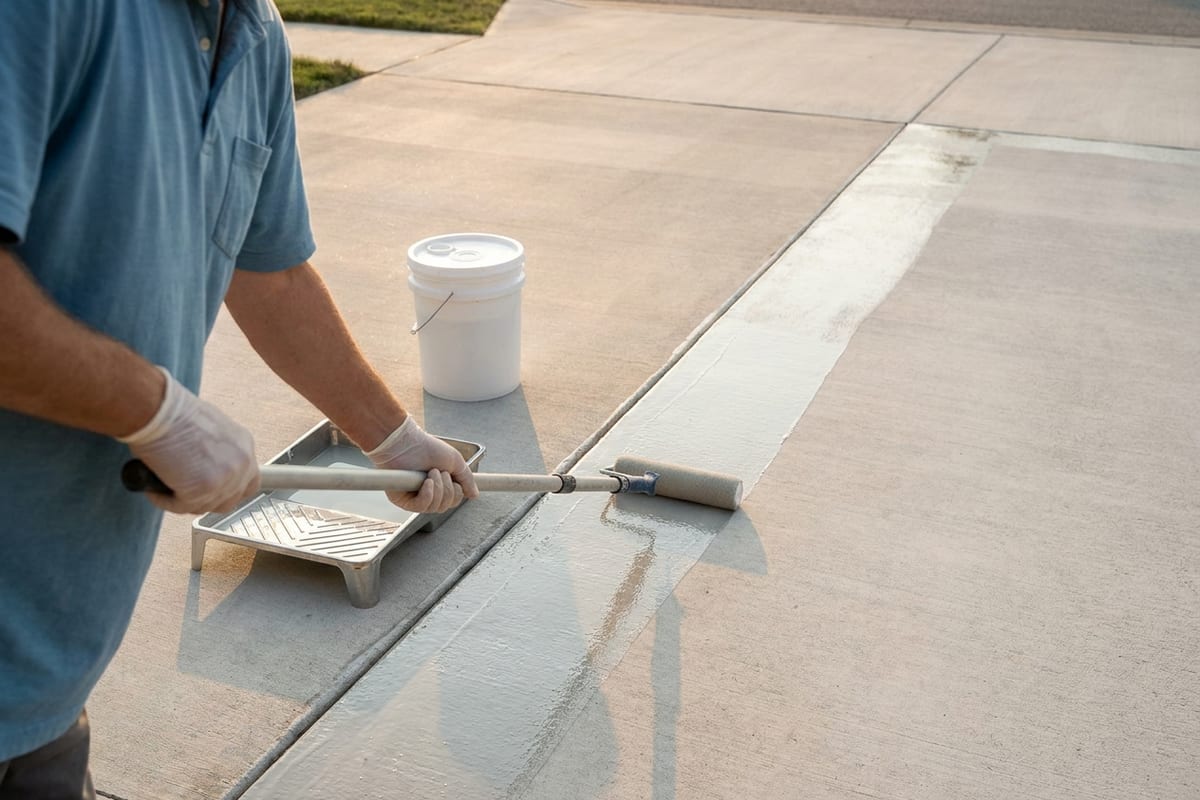
Most professional sealing jobs include two coats. The first coat goes down, soaks in (for penetrating) or begins to bond (for topical), and the second coat follows once the first has dried per label, usually 2 to 4 hours on a warm San Diego day. Single-coat applications cost less but rarely give the same coverage or longevity.
Prep and cleaning
Any sealing quote should include the cost of surface preparation. If your driveway is already clean from a recent pressure wash, prep costs are lower. If it hasn’t been cleaned in years, the prep cost climbs.
Sealing over dirty concrete is one of the more common homeowner mistakes. Dirt, oil, and organic matter get sealed into the surface and the product bonds poorly. The sealer peels or hazes within months. If your driveway needs both cleaning and sealing, driveway cleaning comes first as a separate step.
The timing rule that kills most DIY sealing jobs
This is the one thing that separates a sealing job that lasts from one that fails by spring.
After pressure washing concrete, the surface may look dry within an hour. It isn’t. Water drives into the pores of the concrete during cleaning, and the concrete needs time to release all of it before sealer goes down. If you seal too soon, you trap moisture inside the slab. What happens next depends on the sealer type: topical acrylics develop a milky white haze as the trapped moisture tries to escape. In worse cases, they blister or peel within weeks.
The minimum wait after pressure washing is 48 hours of dry weather. In many situations, especially with dense or older concrete, a full week is better. This is why responsible contractors won’t clean and seal in the same day. The cleaning and sealing are scheduled as two separate visits.
Read more about the cleaning-first sequence in how to clean concrete: a San Diego homeowner’s guide.
San Diego’s dry summer climate actually helps here. A June or July pressure wash can be ready to seal within 48 to 72 hours. A winter cleaning during El Niño conditions, with multiple days of overcast skies and humidity above 70%, needs more time. Sealer label instructions typically say don’t apply below 50°F or above 90°F and don’t apply when rain is expected within 24 to 48 hours. Reputable contractors watch the forecast and reschedule if needed.
How long does sealing last in San Diego?
San Diego is a high-UV environment. The UV index here averages 5 to 8 most of the year, and topical sealers degrade faster under UV exposure than they would in, say, Portland. That’s worth factoring in when comparing product costs.
Topical acrylic sealers: 2 to 3 years for quality products. Cheaper acrylics: 1 to 2 years. You’ll know it’s time to reseal when water stops beading on the surface and the finish looks chalky or faded.
Penetrating siloxane/silane sealers: 5 to 10 years. They don’t fail visibly the same way. A simple water bead test tells you if the repellency is still active. Drip water on the surface. If it soaks in instead of beading up, the sealer is spent.
Paver sealers: varies by product, but plan on 3 to 5 years for a quality commercial-grade paver sealer. Joint sand lockdown starts to loosen before the visible protection fails, so ants and weeds come back as early indicators.
Coastal San Diego properties (La Jolla, Encinitas, Carlsbad, Del Mar) also deal with salt air, which can accelerate degradation of topical coatings. Penetrating sealers that don’t sit on the surface tend to hold up better in high-salt environments.
What sealing actually does for you
Besides the cost and timing details, it’s worth knowing what you’re getting.
Stain resistance. Oil from a leaking car, rust from fertilizer spray or metal furniture, tannin stains from wet leaves, tire marks from parking. Sealed concrete resists all of these because liquids can’t penetrate the surface before you wipe them up. Unsealed concrete acts like a sponge. For driveways with ongoing oil staining, check out rust and oil stain removal before sealing.
Easier cleaning. A sealed driveway comes clean with a light rinse or a quick surface-cleaner pass. An unsealed driveway needs pre-treatment and a longer dwell time every time.
Color enhancement. Topical wet-look sealers darken and saturate the concrete color. This can make plain gray concrete look richer and more intentional. On stamped or colored concrete, a gloss sealer is almost always part of the installation finish from the contractor.
UV protection for colored concrete. Stamped and colored concrete fades under UV. A UV-resistant sealer extends the life of the color significantly. Without it, many decorative concrete installations fade noticeably within 3 to 5 years.
Structural protection (pavers). Sealed pavers with locked joint sand don’t shift, rock, or weed as quickly. The sand stabilization is the more important benefit here, not just the cosmetic finish.
DIY vs pro: where the line is
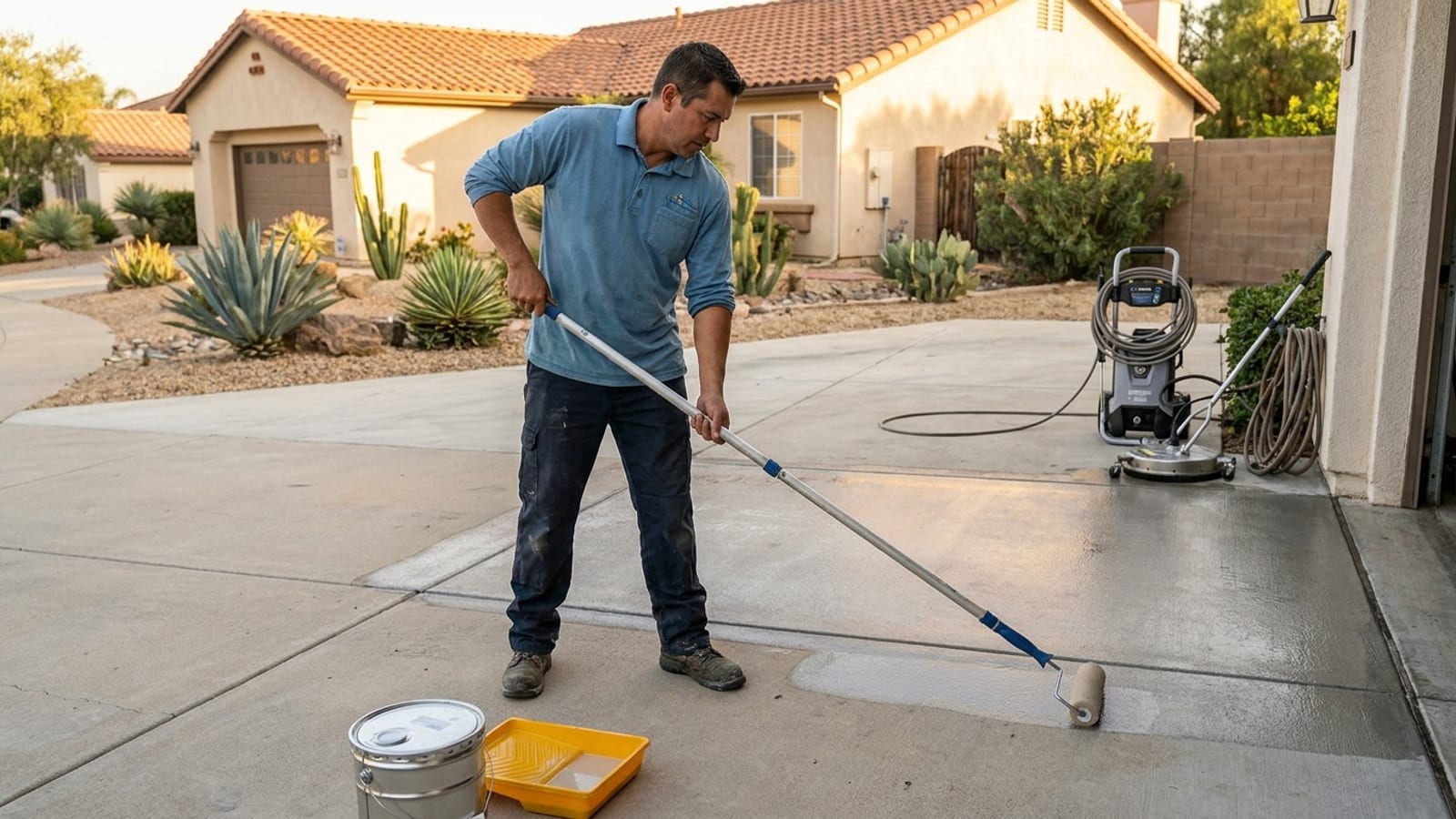
Sealing a simple concrete driveway is within reach for a capable DIYer. The tools are a pressure washer (or surface cleaner), a pump-up sprayer or paint roller, and the right sealer product. The window of errors is narrow, though.
The biggest DIY failure modes are: sealing too soon after cleaning, choosing the wrong product for the concrete type, applying in direct sun on a hot day (the sealer flashes too fast and goes on uneven), and not applying a second coat.
Where pros earn their cost:
- Paver sealing, because of the joint sand work and uniform coverage requirements across irregular surfaces
- Decorative or stamped concrete, where the wrong product choice or a missed spot is obvious and expensive to fix
- Driveways over 800 square feet, where a DIY roller job takes hours and fatigue means uneven coverage toward the end
- Any situation where the concrete has oil stains, rust, or efflorescence that need treatment first
Concrete cleaning paired with professional sealing is usually the better value for anything beyond a simple, flat, clean driveway.
When to call a pro
Call instead of DIYing when:
- The driveway needs cleaning first and you want both done in the same service window
- You have pavers with shifting joints or visible weed growth
- The concrete is stamped, colored, or decorative
- You’ve had a previous sealer that peeled or hazed and want a durable fix
- The driveway is over 600 square feet and you’d rather not spend a Saturday on it
Rinse Pro SD handles the full sequence: driveway cleaning first, scheduled drying time, then professional sealing on the follow-up visit. We use commercial-grade products, not big-box store sealers, and we don’t seal anything we haven’t cleaned ourselves or confirmed is clean and dry.
Call (858) 925-5546 or request a quote online. Upfront pricing with no surprises. We serve all of San Diego County, from Oceanside and Carlsbad down through Chula Vista and Escondido out to El Cajon, Poway, and Alpine.