TL;DR
- Window cleaning in San Diego typically runs $8 to $15 per pane, or $150 to $400 for a whole house exterior.
- Adding interior cleaning, screen cleaning, and track wiping pushes most jobs to $250 to $550.
- Hard-water staining from sprinklers or the coastal salt film costs extra, usually $5 to $15 per pane, because it needs acid or cerium treatment.
- Water-fed pure-water pole systems are now the standard for upper-floor windows and leave a genuinely spot-free result without ladders.
Most window cleaning quotes come in lower than homeowners expect, until the extras add up. A basic exterior-only clean on a single-story home with 15 panes can run $150. That same job with interior cleaning, screen removal and cleaning, track scrubbing, and hard-water stain removal on a two-story coastal home in La Jolla or Carlsbad can easily hit $450 to $550. Here’s exactly what moves the number and how to know what you’re actually paying for.
What window cleaning costs in San Diego
The clearest way to think about pricing is per pane. A “pane” in this context means one piece of glass, one side. So a sliding glass door counts as two panes (left and right), not one, and a typical double-hung window is two panes if you’re cleaning both upper and lower sashes.
Exterior only: $8 to $12 per pane. This is the baseline. Technician cleans the glass from outside, wipes the frame, and moves on.
Exterior plus interior: $12 to $18 per pane. Interior adds time because the tech has to work around furniture, window treatments, and narrow sills.
Whole-house flat rates: Most companies in San Diego quote flat rates by job size rather than strict per-pane math. A single-story home with 15 to 20 panes typically runs $150 to $250 for exterior only. A two-story home with 25 to 35 panes runs $250 to $400. Exterior plus interior on a two-story home is usually $350 to $550.
These ranges reflect real residential quotes in San Diego County. Commercial glass, storefronts, and high-rise work are priced differently and involve different equipment and liability.
What makes the price go up
Number of panes
This one’s obvious but often underestimated. A lot of San Diego homes built in the 1990s and 2000s have large multi-panel sliding doors in every room. A single back wall with three sliding doors can be six or eight panes before you’ve touched the rest of the house.
Single-story vs two-story
A single-story home is faster, simpler, and cheaper. Every window is reachable from the ground or a two-step ladder. Two-story windows require either a ladder setup (slower, riskier) or a water-fed pole system (faster, but the pole and de-ionization equipment represent a real equipment investment). Expect two-story window cleaning to run 20 to 40 percent more per pane than the same house at single-story height.
Three-story, rooflines, and skylights are quoted separately.
Screens
Screens add time at every step. The tech has to remove them, clean them (usually with a soft brush and water), let them dry, and re-hang them. Screen cleaning typically adds $3 to $5 per screen. If screens are damaged or corroded, you may get a separate note recommending replacement rather than cleaning, since a brittle screen tears when handled.
If you skip screen cleaning but the screens stay on the windows, the glass stays dirty. Dust and salt deposit on screens and transfers back to the glass within weeks. It’s worth doing both together.
Tracks and sills
Window tracks collect a combination of dead insects, soil, oxidized aluminum grit, and years of built-up grime. Scrubbing them out with a detail brush, wiping them dry, and leaving them clean takes four to eight minutes per window. Most companies charge $2 to $4 per window for proper track cleaning. It doesn’t sound like much until you’re at 25 windows.
Skipping track cleaning is a common way to cut the quote down, but dirty tracks drain slowly and debris deposits back on the glass at the bottom edge within weeks. Worth including if you haven’t done it in more than a year.
Divided lights and grids
Some windows have actual divided glass panes separated by muntins (real grids). Some have decorative grids that sit on the glass surface. Both require more time per window because each section of glass needs individual attention. A 9-pane divided-light window takes roughly three times as long to clean as a single-pane window of the same size. If your home has a lot of traditional divided lights, get a specific quote rather than estimating from a per-pane average.
Skylights
Skylights are almost always quoted separately and often skipped in standard window cleaning packages. A flat or low-pitch skylight that’s accessible from the roof runs $15 to $35 per skylight depending on size. Steeply pitched roof access raises the price. If hard-water staining is present (very common on skylights in inland areas with sprinklers hitting the roof), add stain removal on top.
Hard-water staining and the coastal salt film
This is the issue that catches San Diego homeowners off guard more than anything else. Two causes, different chemistry.
Sprinkler overspray. Irrigation systems that hit windows deposit dissolved minerals, primarily calcium and magnesium carbonate, directly on the glass. In areas like Escondido, Poway, El Cajon, and inland Chula Vista where tap water runs hard (San Diego Municipal Water runs 200 to 400 ppm total dissolved solids depending on the source blend), these deposits build up into a white haze that gets progressively harder to remove the longer it sits. Basic window cleaning won’t touch it. You need an acid or cerium-oxide treatment to dissolve the mineral bonds.
Marine-layer salt film. Homes within a mile or two of the coast in Encinitas, Del Mar, La Jolla, Pacific Beach, and Ocean Beach get a fine salt and particulate film from the marine layer. It’s not always visible as a white deposit the way inland mineral staining is, but it leaves the glass looking dull and causes streaking that won’t rinse away with plain water. A mild acidic rinse or a glass restoration compound clears it. Frequency matters here: coastal homes often need cleaning every three to four months to stay ahead of the salt buildup, where inland homes can typically go six months between cleans.
Hard-water stain removal is priced as an add-on, usually $5 to $15 per pane depending on severity. Light haze from one or two seasons of sprinkler overspray is on the lower end. Years of buildup that requires a cerium oxide compound and a rotary pad is at the top end. In the worst cases, severely etched glass can’t be fully restored without glass replacement.
If you’re not sure whether what you’re seeing is hard-water staining or just dirt, run a wet finger across the glass. Dirt smears. Mineral deposits feel slightly rough and don’t smear.
Cleaning methods: squeegee vs water-fed pole
The two standard methods each have a place, and a good window cleaning company uses both depending on the situation.
Traditional squeegee. A strip washer applies soapy water to the glass, and a rubber squeegee pulls it off in a single stroke, leaving the glass clean if done correctly. This is the proven method for ground-floor interior windows, french doors, and any glass where the tech is standing close to the surface. Requires soap, a clean blade, and technique. Done right, it’s fast and leaves a very clean result. Done wrong (dull blade, wrong technique), it leaves smears.
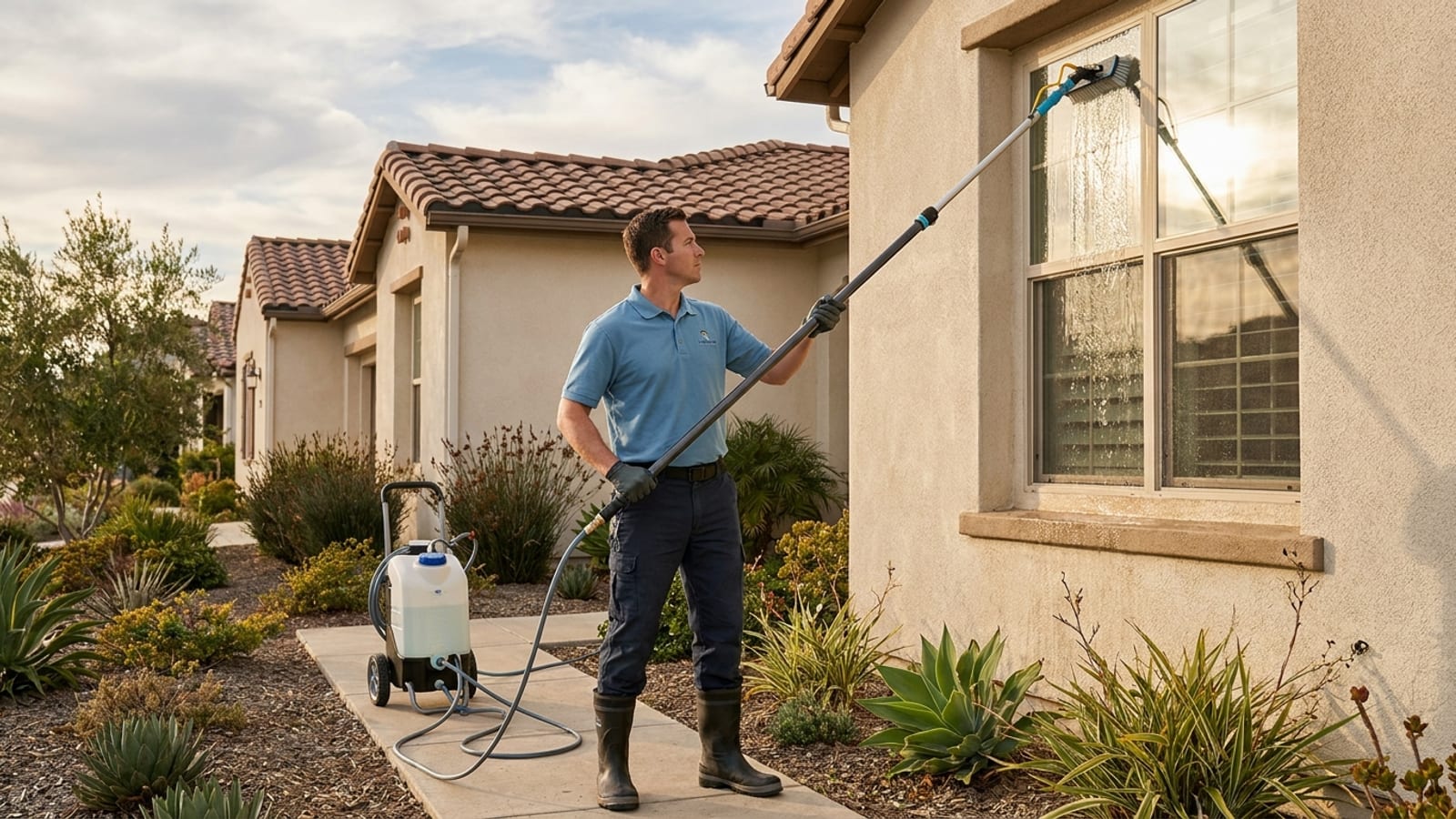
Water-fed pole with pure water. A telescoping carbon-fiber or fiberglass pole extends 25 to 65 feet, fed by a hose connected to a de-ionization or reverse-osmosis system that removes dissolved solids from tap water to near zero. Pure water acts as a natural solvent: it wants to absorb mineral ions, so it pulls contaminants off the glass and leaves nothing behind as it evaporates. The brush on the pole scrubs the glass, the pure water rinses it, and the glass dries spot-free without a squeegee.
This is now the standard method for upper-floor windows in San Diego. It’s faster than ladder work, eliminates ladder hazards, and produces a genuinely spot-free result because there’s no soap residue to attract dust. It does require that the glass be reasonably clean to start. On heavily stained glass, the pure water alone won’t remove mineral deposits. That’s done first with acid treatment, then finished with the pole system.
How often should windows be cleaned
For most San Diego homes, twice a year is the practical minimum. Spring cleaning handles winter’s dust and any marine-layer accumulation, and a fall clean before the rainy season means you’re starting the wet months with clean glass rather than letting rain streak through months of grime.
Coastal homes in La Jolla, Pacific Beach, Carlsbad, and Oceanside benefit from three to four cleanings a year. The salt film accumulates faster than the twice-yearly schedule can address, and light cleaning three times a year is typically less expensive than a full restoration job once a year.
Homes with irrigation systems that hit the windows should schedule cleaning after any sprinkler adjustment, and at minimum twice a year. Letting mineral deposits sit through a full summer of irrigation and heat is how you end up with etched glass that costs more to restore than a year of regular cleaning would have.
Bundling with exterior washing
Window cleaning is often bundled with a full house washing at a meaningful discount. A house wash cleans the siding, fascia, soffits, and exterior surfaces, and adding window cleaning at the same visit is more efficient than two separate appointments. Most companies offer 10 to 20 percent off window cleaning when booked with a house wash.
Gutter cleaning is the other natural pairing. Gutters and windows are both reached from the same equipment and same visit, and gutter debris blows back onto windows if the downspouts are dirty. See our window and gutter cleaning service for combined pricing.
After a house wash or window cleaning, the exterior is also a good time to evaluate the driveway and flat surfaces. Dirty concrete and a clean house look mismatched fast. Our pressure washing service in San Diego covers all exterior surfaces if you want to do it all in one appointment.
DIY vs professional window cleaning
A squeegee, a strip washer, and a bucket of Dawn and water will clean ground-floor windows well enough if you have the time and don’t mind the technique learning curve. The equipment isn’t expensive: a good Ettore or Unger squeegee runs $20 to $30.
What you can’t replicate without significant investment is the water-fed pole system. A decent residential unit costs $400 to $800, and the de-ionization cartridges are consumable. For upper-floor windows, DIY means ladders, which is where most residential window cleaning injuries happen.
The real value of professional window cleaning is the full package: screens removed and cleaned, tracks scrubbed, hard-water stains identified and treated, and upper-floor glass cleaned without ladder risk. That’s four or five hours of careful work on a typical two-story home. For most homeowners, the math favors booking a pro twice a year over the time, equipment, and effort of doing it themselves.
If you want to DIY ground-floor windows between professional visits, a water-fed hose with a detachable brush (sold at most hardware stores for $30 to $50) is a reasonable maintenance tool. It won’t replace a proper clean with the right chemistry, but it extends the time between professional appointments.
When to call a pro
Book professional window cleaning when any of these apply:
- Windows are two-story or higher and you don’t have safe ladder access
- Hard-water staining or mineral haze that doesn’t come off with normal cleaning
- You haven’t had a full clean including screens and tracks in more than a year
- Moving into or out of a home where you want a complete reset
- Preparing for a home sale or inspection
- After construction, renovation, or a concrete or masonry project nearby where dust has settled on the glass
For hard-water staining specifically, the longer you wait, the harder and more expensive it gets to remove. Mild haze from one season is a one-step acid treatment. Two or three years of buildup may need multiple treatment cycles. Genuine etching from years of neglect can be permanent.
Call (858) 925-5546 or request a quote online. We provide upfront pricing before we start, with no surprise add-ons. We serve all of San Diego County, from Oceanside and Carlsbad down through Chula Vista to Imperial Beach, and inland to El Cajon, Escondido, and Alpine.