TL;DR
- Composite and Trex decking grows mold and mildew in shaded San Diego yards, especially coastal ones with persistent marine layer.
- Most composite manufacturers cap pressure around 1,500 to 3,100 PSI, but soft washing with a fan tip at low PSI is safer and keeps the warranty intact.
- Use an oxygenated deck cleaner (sodium percarbonate) or mild soap. Avoid straight bleach on many brands, it can lighten the color permanently.
- Scrub with the grain using a soft-bristle brush, never a stiff wire brush, and never let cleaner dry on the boards.
Composite decking gets sold as low-maintenance, and compared to raw wood it is. You don’t stain it. You don’t seal it. You don’t worry about splinters. But “low-maintenance” is not “no-maintenance,” and homeowners in San Diego find that out fast.
Coastal neighborhoods from Encinitas to Ocean Beach sit under a marine layer most mornings. That moisture, combined with shaded yard layouts and salt air, creates the exact environment where mold, mildew, and algae settle into the grain pattern of composite boards. Inland homes in Santee, El Cajon, and Escondido get less of that but deal with hard-water staining from sprinkler overspray and grill grease that builds up slowly over years. Either way, the deck needs cleaning, and cleaning composite the wrong way causes permanent damage that no manufacturer will cover.
Here’s exactly how to do it right.
Why composite decks aren’t actually maintenance-free
First-generation composite decking, boards made before about 2010, was essentially a wood fiber and plastic blend with no capping on the outside. Those boards absorbed moisture, stained easily, and were more or less a mold magnet. Most manufacturers now make what they call capped composite, where a polymer shell wraps the outer face of each board. Trex, Fiberon, TimberTech, and Azek all have capped products.
Capped composite is genuinely better. It doesn’t absorb as much water and it resists staining more effectively. But the grooves between boards trap leaves, pine needles, and organic debris. Once that debris sits there through a few wet coastal mornings, mold starts growing. The cap surface itself also develops a thin biofilm layer over time. Leave it alone for a few years and the deck can look genuinely gray-green, especially in shaded spots.
The cleaning problem is that composite looks like it should be pressure washed. It’s not wood. You’d think you could point a pressure washer at it and get it clean fast. What actually happens is the pressure frays the surface fibers if you go too high, and on capped composite it can actually abrade the outer cap layer. Once you’ve fuzzed composite boards, the surface feels rough to bare feet, traps more dirt going forward, and there’s no fix short of replacement.
A single pass with a zero-degree red tip on composite is enough to cause visible damage. That’s the kind of mistake that costs $5,000 to $15,000 to fix on a mid-size deck.
What the manufacturers actually say
Trex’s cleaning guidelines specify a maximum of 3,100 PSI with a 25-degree fan tip held at least 8 inches from the surface, moving continuously. Fiberon and TimberTech both recommend staying under 3,000 PSI and sweeping in the direction of the grain. Azek, which is a PVC product rather than composite, is even more sensitive and recommends staying under 1,500 PSI.
The important caveat is that these are maximum thresholds, not targets. Those limits assume you’re using a properly held fan tip, moving continuously, and never stopping in one spot. In practice, soft washing at 600 to 1,200 PSI with good chemistry does a better job than borderline-high-pressure cleaning and is much more forgiving of normal user variation.
If you have an older first-generation composite deck without capping, stay under 1,500 PSI no matter what. Those boards are softer and more porous.
Check your specific product if you can. Manufacturer websites have current cleaning guidelines, and if your deck is within the last ten years you can usually look up the board name stamped on the board ends or on the original receipt.
The right cleaner for composite decking
Chemistry matters as much as pressure for composite. Here’s what works and what to avoid.
Oxygenated cleaners (sodium percarbonate). These are the safest option for composite. Products like Defy Composite Deck Cleaner, Star Brite Non-Skid Deck Cleaner, or generic sodium percarbonate deck cleaners activate with warm water and break down mold, mildew, and organic staining without bleaching the composite color. Most manufacturers explicitly recommend them. Mix per label and let them dwell.
Mild dish soap. For light surface dirt and grime, a few squirts of dish soap in a bucket of warm water with a soft brush works fine. This isn’t for mold, it’s for surface dust and pollen.
Diluted bleach. Sodium hypochlorite in low concentration (1 to 2 percent) will kill mold effectively. The problem is that some composite brands, particularly older or lighter-colored boards, are sensitive to bleach and can lighten unevenly. Always test in an out-of-the-way spot before applying bleach broadly. Some manufacturers void the warranty for bleach use. Check your brand before you go this route.
What not to use. Straight concentrated bleach, acetone, paint thinner, or abrasive powder cleaners will damage composite surfaces. Oil-based deck cleaners meant for wood will leave a film on composite that attracts more dirt. Trisodium phosphate (TSP) is also too aggressive for most composite.
If you’re dealing with a stubborn grease stain from a grill, a small amount of dish soap or a diluted citrus degreaser worked in with a soft brush is the right approach. Don’t go straight to sodium hydroxide degreasers designed for concrete, those are too alkaline for composite.
Step-by-step: how to clean composite decking
Here’s the full sequence.
1. Clear and sweep
Get everything off the deck: furniture, planters, grills, rugs. Sweep the whole surface with a standard push broom to clear loose debris. Pay attention to the gaps between boards, leaves and pine needles that have compacted in there need to come out. A putty knife or stiff plastic-bristle brush works well to clear the gaps.
2. Pre-rinse
Run a garden hose or a pressure washer on low (white 40-degree tip, held well back) across the whole deck. This wets the surface and starts loosening surface dust before the cleaner goes down. Pre-rinse helps the cleaner spread more evenly.
3. Apply the cleaner
Mix your oxygenated cleaner per label instructions. Apply it with a pump-up sprayer or pour it directly from a bucket and spread with a brush. Work in sections if the deck is large so the cleaner doesn’t dry out before you scrub. On a warm San Diego day, direct sun will flash a cleaner off the deck fast. Work in shade when you can, or work early morning when the deck is still cool.
Let the cleaner dwell for 10 to 15 minutes. You’ll see mold and mildew start to lighten. That’s the chemistry working. Mist the surface again if it starts to dry before the dwell is up.
4. Scrub with the grain
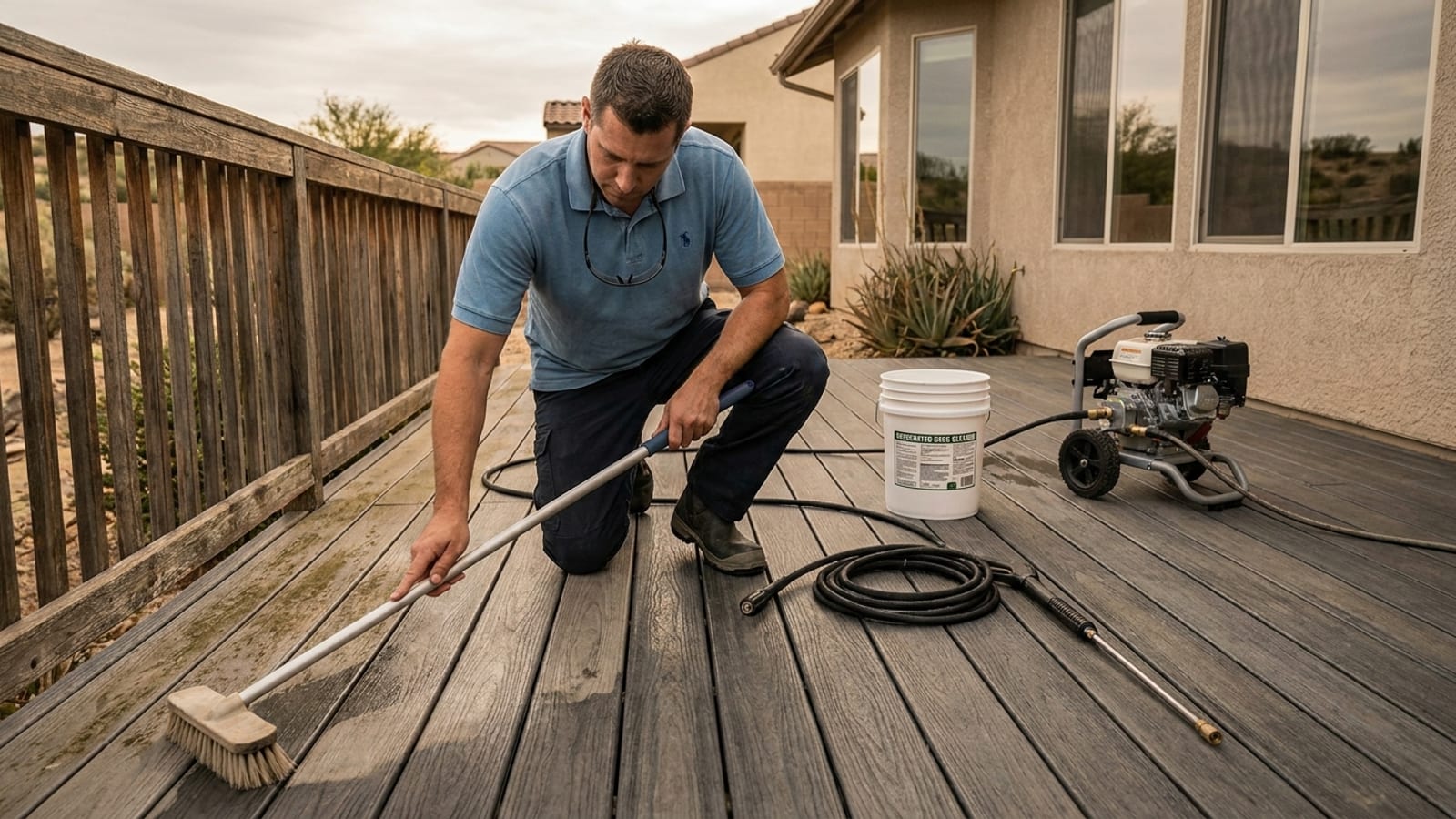
Use a soft-bristle deck brush, the kind sold for composite or fiberglass boat decks. Scrub in the direction of the board grain, not across it. Scrubbing across the grain can abrade the surface texture and leave visible marks.
Work methodically, one board width at a time. For stubborn spots, reapply cleaner and let it dwell another 5 minutes before scrubbing again. Don’t use a wire brush or stiff-bristle utility brush, both will scratch capped composite.
For grease stains near a grill, apply a small amount of diluted dish soap directly to the stain, work it in with a soft brush in circles, then return to with-the-grain scrubbing. Give it more dwell time than regular mold stains.
5. Rinse thoroughly
Rinse with a garden hose on full pressure or a pressure washer with a 40-degree white tip at low PSI. Rinse in the direction of the grain. Make sure all cleaner is off the surface, residue left behind will attract dirt and can cause streaking. Rinse the gaps between boards especially well.
If you’re using a pressure washer, a 25-degree green tip at 800 to 1,200 PSI held 12 inches from the surface is appropriate. Keep the wand moving. Don’t stop in one place and don’t angle the tip directly into the board gaps at close range.
What not to do
These are the mistakes that cause permanent damage.
Zero-degree red tip. Never. On any composite surface. It will fuzz the boards on contact.
Tip too close. Even a 25-degree tip will damage composite if it’s held 3 inches away. Maintain at least 8 inches minimum, 12 is better.
Letting cleaner dry on the boards. Oxygenated cleaners are safe at the right dwell time. If they dry on, they can leave a residue that takes multiple rinse cycles to clear and may leave faint marks on darker boards.
High pressure in the board gaps. Pointing a high-pressure tip directly into the gap between boards at close range can work the tip of the board loose from the hidden fastener and create a raised edge. It can also blast any grit between boards against the underside of the adjacent board and score the surface.
Pressure washing first-gen composite at high PSI. If you’re not sure whether your deck is capped or uncapped, assume it’s uncapped and stay under 1,500 PSI with a 40-degree tip.
Grease stains and ground-in grime
Grill grease is the stubborn one. It settles into the grain pattern of composite boards and can look like a permanent dark strip along the length of a board in line with the grill. A single dwell cycle won’t always get it.
For heavy grease buildup, apply a small amount of citrus-based degreaser or concentrated dish soap to the stain. Work it in with a soft brush, let it sit for 20 minutes, then scrub again before rinsing. On very old grease stains, you may need two or three cycles before you see meaningful improvement. It helps to do this in warmer weather when the degreaser stays active longer.
Ground-in grime that has worked into the grain texture over multiple years is best addressed with an oxygenated cleaner at full concentration per the label, full dwell time, and thorough scrubbing. You’re not always going to get composite back to day-one appearance if it’s been neglected for several years, but you can get it significantly cleaner.
See our deck and patio cleaning page for the professional approach if the DIY cycles aren’t getting there.
When to call a pro
DIY composite cleaning makes sense for a single-story deck that’s been maintained reasonably well. There are situations where calling a pro is the better call.
First-generation uncapped composite. Older boards are more porous and more sensitive to both pressure and chemistry. Getting it wrong is a real risk. A professional deck and patio cleaning service with experience on composite knows the thresholds by feel.
Large second-story decks. Working off a ladder with a pressure washer while managing a spray wand overhead is genuinely dangerous. Second-story decks also have safety equipment and access requirements that change the job significantly.
Mold that has fully penetrated the grain. If the deck has been neglected for three or more years and mold is deep in the texture, a single DIY cleaning often lifts the surface layer and reveals how much is still underneath. A pro treatment with the right chemistry, dwell time, and low-pressure soft wash tends to get more complete results in one pass.
Before you sell or refinish. If you’re selling the house or installing new outdoor furniture and want the deck to look its best, a professional result is usually worth it. We soft wash decks across San Diego County and know how to handle composite without voiding the warranty or damaging the surface.
If you’d also like the concrete around the deck cleaned at the same time, our concrete cleaning and pool deck cleaning services cover surrounding flatwork in the same visit.
How often to clean composite in San Diego
Most composite deck manufacturers recommend cleaning once or twice a year. In San Diego, homes in coastal neighborhoods (La Jolla, Encinitas, Carlsbad, Oceanside) that get regular marine layer should lean toward twice a year, once in spring before outdoor season and once in fall after summer use. A light rinse every few months helps keep debris from compacting in the gaps.
Inland homes in Poway, Santee, or Alpine can often get by with an annual deep clean, with spot cleaning for any grill grease or visible staining as it comes up.
Staying on a regular schedule is a lot easier than doing a heavy remediation clean on a deck that’s been ignored for five years.
Ready to let a pro handle it?
If you’d rather not manage PSI limits and cleaner dwell times on a weekend afternoon, call (858) 925-5546 or request a quote online. We offer upfront pricing, fast scheduling, and serve all of San Diego County from Oceanside to Chula Vista and inland to Alpine. We know composite and Trex decking, and we clean it without the risk of voiding your warranty or fuzzing the boards.