TL;DR
- Pressure-washing wash water is regulated in San Diego under the federal Clean Water Act, the state’s Industrial General Permit, and the San Diego regional MS4 stormwater permit.
- For residential jobs, the rules are light, local wastewater rules mostly apply.
- For commercial jobs (parking lots, drive-thrus, fuel stations, industrial facilities), wash water usually cannot go into a storm drain. It must be captured, contained, and disposed of properly.
- Property owners share liability. If a contractor pressure-washes your lot and the water hits a storm drain, enforcement can target either party.
- Always ask commercial pressure-washing bidders how they handle wash water before hiring. A real answer is worth more than the cheapest bid.
If you own a San Diego commercial property, a restaurant with a drive-thru, a fuel station, a shopping center, a dumpster pad, or an industrial facility, the water that runs off the ground after a pressure washing job is regulated. Not lightly regulated. Under the federal Clean Water Act, California’s Industrial General Permit, and the San Diego regional stormwater permit, wash water that reaches a storm drain without proper treatment is a prohibited non-stormwater discharge.
Here’s who regulates it, what the rules actually require, and how compliant pressure washing works in practice.
Who writes the rules
Pressure-washing wash water in San Diego County sits at the intersection of three regulatory layers:
1. Federal, EPA’s Clean Water Act (NPDES)
The Clean Water Act (1972) requires a National Pollutant Discharge Elimination System (NPDES) permit for most discharges into waters of the United States. Storm drains in San Diego are direct conduits to creeks, the San Diego River, coastal lagoons, and the Pacific. EPA’s NPDES program is the federal-level framework, but implementation is delegated to California.
2. State, California’s Industrial General Permit
The California State Water Resources Control Board runs the Industrial General Permit. Mobile pressure-washing operators, our category, may be covered under it, or may operate under specific guidance for mobile businesses issued by the regional boards. Operators that cross sites regularly should confirm their regulatory status with the San Diego Regional Water Quality Control Board.
3. Regional/local, The San Diego MS4 permit
The current regional stormwater permit in San Diego is Order R9-2013-0001 (the Municipal Separate Storm Sewer System, or “MS4” permit) as amended. It binds San Diego County and every municipality in the county. Under it, each jurisdiction enforces local stormwater ordinances. For pressure washing, the relevant language appears in each city’s municipal code, for example, San Diego Municipal Code Chapter 4, Article 3 covers stormwater management.
The short read across all three layers: non-stormwater discharges to storm drains are generally prohibited unless specifically exempted. Pressure-washing wash water is not on the exempt list.
Residential vs commercial, the practical split
Enforcement focus has always been commercial and industrial work. Here’s how the practical split typically works:
Residential pressure washing (your driveway, your house, your back patio, your pool deck):
- Wash water mostly runs onto your landscape and infiltrates the soil, which is generally fine.
- If wash water runs to the street and into a storm drain, and it carries oil, soap, or chemicals, it can technically be non-compliant, but municipal enforcement is almost always focused elsewhere.
- Contractors should still minimize runoff, pre-treat oil stains separately, and avoid washing in active rain events.
Commercial pressure washing (parking lots, drive-thrus, fuel stations, dumpster pads, fleet vehicles, industrial pads):
- Wash water cannot flow to the storm drain.
- Must be captured and disposed of properly, typically to the sanitary sewer with permission, to a properly permitted treatment facility, or held and hauled.
- Both the pressure-washing contractor AND the property owner can be cited. Joint liability is the norm.
If you run or own a commercial property in San Diego and you hire a pressure washer who “just sprays it down and lets it run,” you’re carrying the liability.
The BMPs that compliance actually requires
Environmental regulators publish Best Management Practices (BMPs) that spell out the operational controls compliant contractors follow. For mobile pressure washing, the core BMPs are:
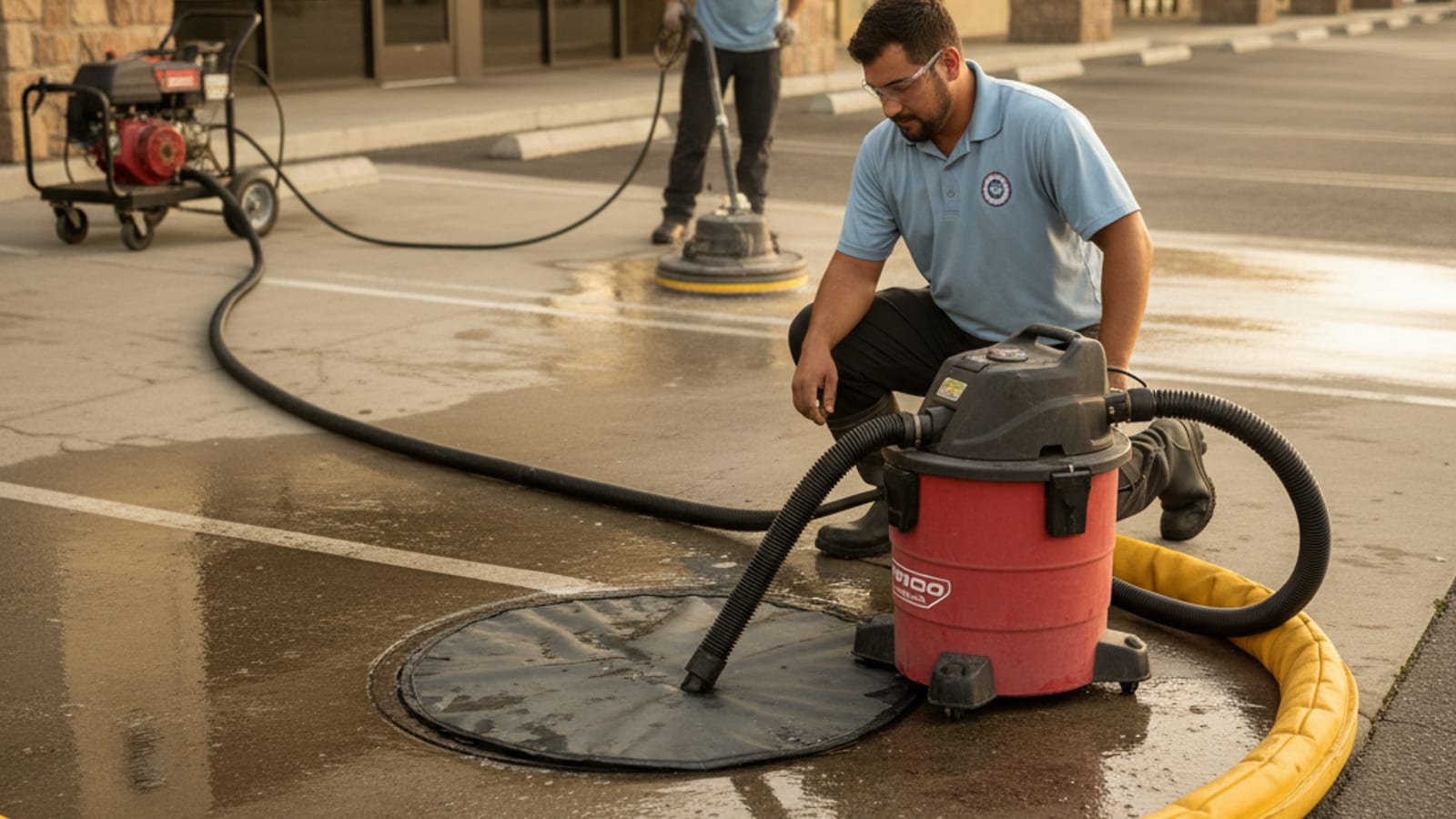
Wash-water capture
Physical containment on the work area. Common methods:
- Berms: soft or hard water dams placed around storm drains or at the perimeter of the wash area.
- Drain covers and plugs: temporary seals over nearby storm drain inlets during the work.
- Wet vacuums: industrial vacuums that recover wash water from the surface as it’s generated.
- Vacuum-boom systems: integrated systems that capture water at the point of surface cleaning.
Pro-grade pressure-washing rigs carry this equipment as standard on commercial jobs. If a contractor shows up without any of it for a parking-lot job, they’re not operating compliantly.
Pre-cleaning
Before turning on water:
- Sweep up visible debris and trash. Don’t use the pressure washer as a broom.
- Pre-treat oil stains with absorbent (clay, sawdust, or commercial absorbent pads), then dispose of the contaminated absorbent properly.
- Contain large debris on-site rather than washing it toward the drain.
Chemistry discipline
- Use biodegradable detergents wherever possible.
- Minimize chemical volumes.
- Match the detergent to the job, gentler chemistry on food-service pads, degreaser on mechanical pads.
- Never pour spent chemistry down a storm drain. Recover and dispose per label instructions and local rules.
Disposal routing
The captured wash water has to go somewhere. The correct routing is typically:
- Sanitary sewer connection (with permission from the wastewater agency). In San Diego, this usually means coordination with the City of San Diego Public Utilities Department or the property’s local sewer agency.
- On-site permitted treatment (oil/water separators with periodic servicing).
- Haul and dispose at a permitted treatment facility. Tracked by manifest.
Weather avoidance
Don’t pressure wash during active rain events on a commercial job. Wash water mixes with stormwater flow and containment becomes effectively impossible.
Documentation
For regulated commercial work, contractors typically keep:
- Job logs with date, location, scope of work.
- BMP checklists per site.
- Disposal manifests for hauled water.
- Training records for crew members.
What San Diego property owners should ask before hiring
Before you sign with any commercial pressure-washing contractor, ask:
- “How do you handle wash water on this job?” A specific answer (berm the drains, run the wet-vac, haul to permitted disposal) is a green flag. “We just rinse it down” is a red flag.
- “Can I see your insurance certificate?” General liability plus auto plus workers’ comp. Any legitimate commercial pressure-washing contractor carries all three.
- “Where does the captured wash water go?” Pressure washing is cleaning work, so California has no state contractor license for it. What separates real commercial operators is disposal: a named permitted disposal site or sanitary-sewer authorization beats a vague “we take care of it.”
- “Do you have a BMP plan for my site?” A real contractor has a site walk-through and will identify the storm drains, the capture plan, and the disposal routing before quoting.
- “Who carries the liability if wash water hits the drain?” A contractor confident in their process will put it in writing.
If a contractor can’t answer these questions, the cheaper bid is hiding costs, legal, environmental, and reputational, that you’ll absorb later.
How residential and commercial diverge in practice
We do both at Rinse Pro SD, and the site prep is genuinely different:
- Residential driveway: pre-rinse landscaping, spot-treat oil stains, run the hot-water surface cleaner, direct final rinse toward the planting bed rather than the street. Simple.
- Commercial drive-thru pad or dumpster area: drain covers down, perimeter berm up, wet-vac plugged in, pre-sweep, pre-treat grease traps, capture 100% of the wash water, haul to permitted disposal. Costs more. Takes longer. Meets the regulation.
The difference is not optional. It’s the job.
What happens when contractors cut corners
Municipalities and the Regional Water Quality Control Board can issue:
- Notices of violation against property owners and contractors
- Cease-and-desist orders
- Administrative penalties, with amounts that vary by violation type. Check current fee schedules with the San Diego RWQCB.
- Referral to state or federal prosecution for serious / repeat violations
Property owners absorb some or all of it jointly. “I hired a contractor” does not relieve the property owner when the violation is on their parcel.
The broader cost is harder to measure but real: lost public trust, neighborhood complaints, and reputational damage with a city you do business with.
The honest short version
If you’re a San Diego homeowner and your driveway needs washing: hire an insured pro, don’t overthink the stormwater rules, ask them to direct rinse water to landscape rather than the street.
If you own or operate commercial property: the rules are real, the liability is joint, and the cheap contractor is usually cheap because they’re not carrying BMP equipment. Ask the five questions above before you sign.
If you’re a pressure-washing operator in San Diego: current general liability and workers’ comp plus a written BMP plan are the minimum kit. Beyond that, investing in wet-vac capture, berm kits, and a permitted disposal relationship is not optional for commercial work, it’s the market.
Sources and further reading
- EPA National Pollutant Discharge Elimination System (NPDES): epa.gov/npdes
- California State Water Resources Control Board, Industrial General Permit: waterboards.ca.gov, industrial stormwater
- San Diego Regional Water Quality Control Board: waterboards.ca.gov/sandiego
- San Diego Municipal Code Chapter 43, Article 3 (stormwater): docs.sandiego.gov
- Power Washers of North America (PWNA) BMP resources: pwna.org
- UAMCC methodology references: uamcc.org
Methodology note
This post summarizes the publicly published regulatory framework as of 2026-04-23. It is not legal advice. Operators should contact the San Diego Regional Water Quality Control Board or their local municipality for current requirements on a specific site. Property owners unsure about their obligations should consult their environmental compliance advisor. Prices, fines, and specific permit fees were omitted where the current published numbers were not available at time of writing, a human editor should add current specifics from the authoritative sources linked above before this post is published.
Need a commercial pressure-washing contractor who runs the BMPs properly? Call Rinse Pro SD at (858) 925-5546 for a free on-site estimate that includes the site-specific stormwater plan.