TL;DR
- Coastal San Diego (within 2 miles of ocean): soft wash every 18 to 24 months.
- Inland (Escondido, Poway, Alpine): every 2 to 3 years.
- East County dust belt (El Cajon, Santee, Lakeside): every 3 years is plenty.
- Always assess by the north and west-facing walls, they’re always the worst.
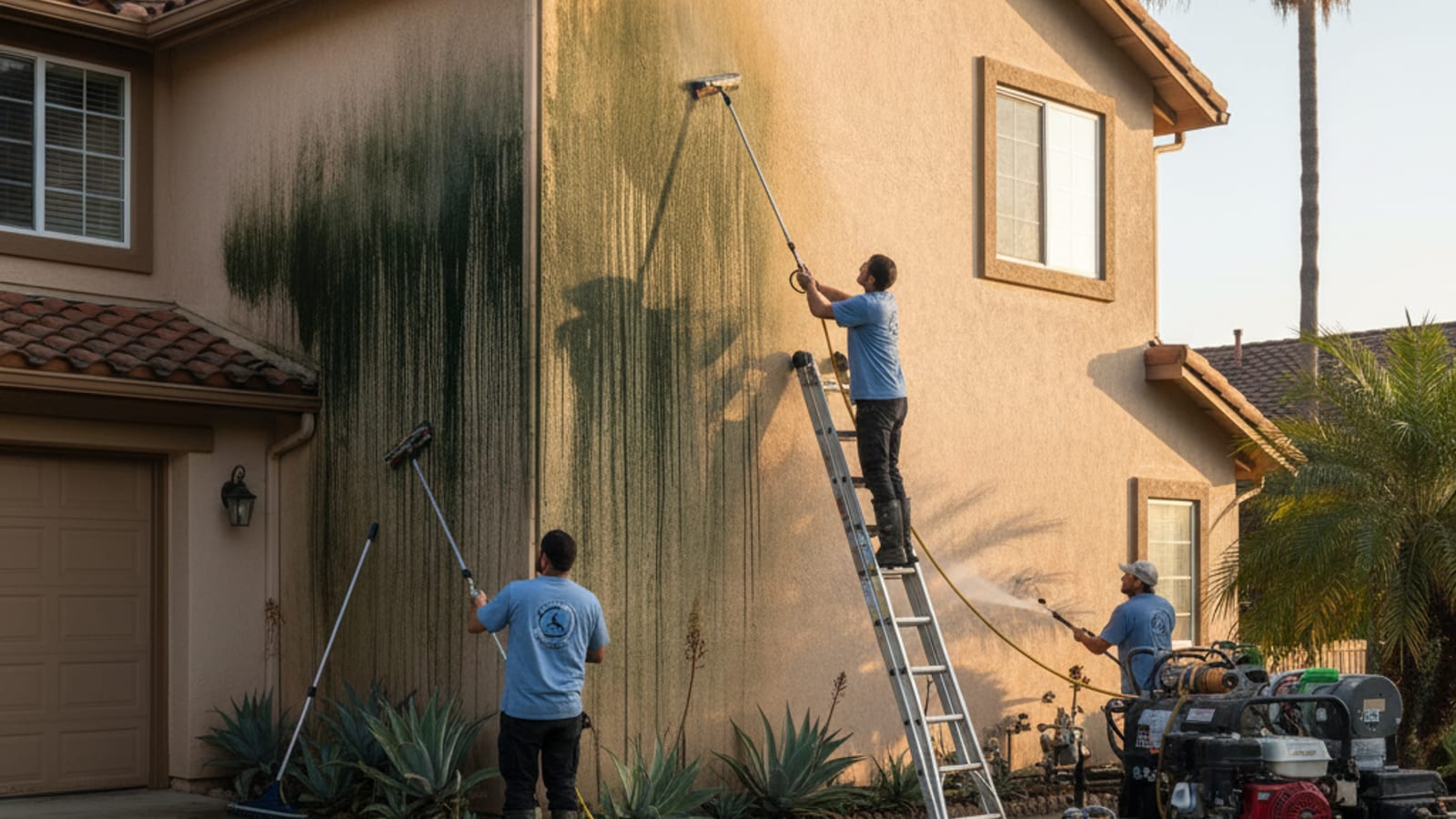
- Signs it’s time: visible black streaks, green tinge on shaded walls, chalky dull texture, cobweb accumulation around eaves.
“How often should you pressure wash your house?” gets a different answer depending on who’s writing. National blog posts say every year. The paint industry says every 2 to 5. Your uncle in Phoenix washed his house in 1997 and says it’s still fine. For San Diego County specifically, the honest answer varies by microclimate, and it matters because over-washing costs money you don’t need to spend and under-washing lets algae embed in the siding to the point where the damage becomes permanent.
Here’s the actual interval you need by San Diego location, plus the five visual signs that mean it’s time regardless of the calendar.
The real driver: moisture plus shade
Three things feed algae growth on a home’s exterior: moisture, shade, and organic material (pollen, dust, cooking grease in the air, etc). San Diego’s coastal strip delivers all three. Our inland and desert-edge neighborhoods deliver much less.
Moisture-wise, coastal San Diego gets its house exteriors wet almost every morning from April through September via marine layer fog. By the time the fog burns off around noon, the siding has been damp for 4 to 8 hours. That’s 4 to 8 hours of ideal conditions for gloeocapsa magma (black algae), cladosporium (mildew), and a dozen other organisms to multiply.
Inland neighborhoods, east of I-15, essentially, see fog maybe 20 mornings a year instead of 200. Their exteriors dry within an hour of sunrise. Algae growth is 4 to 6 times slower.
This is why no single “every X years” answer works for all of San Diego County.
Intervals by neighborhood
Coastal (within 2 miles of ocean): every 18 to 24 months
This covers: Oceanside, Carlsbad, Encinitas, Cardiff, Leucadia, Solana Beach, Del Mar, La Jolla, Pacific Beach, Mission Beach, Ocean Beach, Point Loma, Coronado, Imperial Beach.
In this zone, a properly soft-washed home will start to re-streak visibly at month 18 to 24. North- and west-facing walls re-streak first; south and east walls take longer. By month 30, the re-streaking is usually obvious from the street.
If you live here and you’re washing your house every 4 years, you’re letting algae embed into the stucco or siding long enough that each wash takes more chemistry and produces less-complete results. The cleaning becomes cumulatively harder instead of easier.
Near-coastal (2 to 5 miles inland): every 24 to 30 months
This covers: Vista (west side), San Marcos (west side), Rancho Santa Fe, Carmel Valley, Mira Mesa, Sorrento Valley, Bay Park, Clairemont, Bonita, Chula Vista (west side), Eastlake north.
Marine layer reaches in regularly but less persistently. Interval stretches from 18 to 24 months out to 24 to 30.
Mid-county inland (5 to 15 miles inland): every 2.5 to 3 years
This covers: Escondido, San Marcos (east side), Vista (east side), Poway, Rancho Peñasquitos, Scripps Ranch, Kearny Mesa, Mission Valley, Allied Gardens, Tierrasanta, Del Cerro, La Mesa, Chula Vista (east side), Eastlake south.
Fog reaches here maybe 30 to 60 days a year, mostly in June and July. Algae growth is slower but not stopped. Interval is 2.5 to 3 years for most homes.
East County dust belt: every 3 years
This covers: El Cajon, Santee, Lakeside, Lemon Grove, Spring Valley, Jamul, Alpine, Ramona.
Marine layer rarely reaches here. The washing driver is different. Santa Ana wind events push dust, dirt, and pollen against north-facing walls, especially in fall. Less algae, more dirt. A regular cleaning every 3 years is sufficient for most homes.
Backcountry and desert edge: every 4 to 5 years (if that)
This covers: Julian, Pine Valley, Borrego Springs, Descanso, Warner Springs.
Dry climate, minimal algae. Most homes out here only need washing to clear dust and pollen accumulation. A cleaning every 4 to 5 years handles it unless there’s a specific problem.
Five signs it’s time, regardless of calendar
Calendar intervals are a rough guide. These visual signs are better.
1. Black streaks on the siding or under the roof eaves
That’s the algae. Once you can see it clearly from the sidewalk, you’ve missed the easy-cleaning window. The streaks themselves come off with a proper soft wash, but each additional month they sit there, the deeper the colony embeds into the stucco or paint pores. See our gloeocapsa magma explainer for the biology.
2. Green tint on shaded walls
Mildew and algae colonies look green before they go black. A green tinge on a north-facing wall, especially one under a tree, is an early warning. Washing at the green stage is easier and cheaper than waiting for the black.
3. Chalky or dull paint color
If you run your hand across the siding and it comes away with a dusty white residue, that’s oxidized paint plus accumulated grime. The paint isn’t damaged yet, but it will be if left. A soft wash restores a surprising amount of depth to dull paint.
4. Cobwebs, wasp nests, and debris at eaves and downspouts
Organic buildup at eaves and around downspouts means moisture is sitting in those areas regularly. Cobwebs accumulate dust, which feeds algae and mildew. Visible eave debris is usually a sign of 2+ years since cleaning.
5. Visible streaking from runoff
After a rain, if you see dark streaks running from under the gutters down the siding, that’s algae colony material dislodging and washing down. That means there’s a lot more still on the siding above.
Seasonal timing in San Diego
The best months to soft wash in San Diego County:
- April through June: Ideal. Weather is stable, marine layer still keeps chemistry from flashing off too fast, temperatures pleasant for the crew.
- September through November: Second-best window. Santa Ana events make late October tricky, but most days are workable.
Months to avoid:
- January and February: Storm risk during dwell. Not impossible, but scheduling is harder.
- Mid-July through August: Hot and bright. Chemistry flashes off faster in direct sun. Pros work early morning during this window.
- December: Rain chance combined with holiday booking logjam.
Over-washing and under-washing
Both have costs.
Over-washing (washing annually on the coast, every 2 years inland) costs you more in service fees than you’re getting in benefit. The algae hadn’t re-grown enough for the cleaning to make a visible difference. That’s a $400 bill for a wash that wasn’t needed yet.
Under-washing (waiting 4+ years on the coast) lets algae colonies embed deeply into stucco pores. Each wash after that is harder, takes more chemistry, and produces less-complete results. In the worst cases, stucco that hasn’t been washed in 8 to 10 years, the staining becomes permanent and only repainting the house fully removes it.
The sweet spot is washing just before you’d start to see visible streaking from the street. On the coast, that’s 18 to 24 months. Inland, 2 to 3 years. East County, every 3.
Does this apply to just the siding, or the whole exterior?
The interval above is for siding soft wash specifically. Other exterior elements have their own schedules:
- Roof (asphalt or tile): Every 3 to 5 years via soft wash, or earlier if visible black streaks appear
- Concrete driveway: Every 18 to 24 months for visible clean appearance; every 12 if you park cars with oil leaks
- Wood fence or deck: Annually if unsealed; every 2 years if sealed; restain every 3 years
- Pool deck: Annually, or before seasonal entertaining
- Gutters (exterior wash): Usually done with the house wash, add about $60 to $120
A comprehensive annual or biennial cleaning package typically combines house + driveway + entry walkway. Most homeowners on the coast book this kind of package every 18 to 24 months; inland every 2 to 3 years.
Booking ahead matters in spring
Our spring booking calendar (March through June) fills up 3 to 4 weeks out. If you know you want a house wash before summer entertaining, book in February. Fall (September through November) books 1 to 2 weeks out.
Call (858) 925-5546 or text us a photo of your house’s worst-affected wall through the contact form and we’ll give you a quote plus an interval recommendation based on your specific neighborhood’s microclimate. Upfront pricing and fast response. Serving all of San Diego County from Oceanside through the coast to Imperial Beach and inland to Alpine.