TL;DR
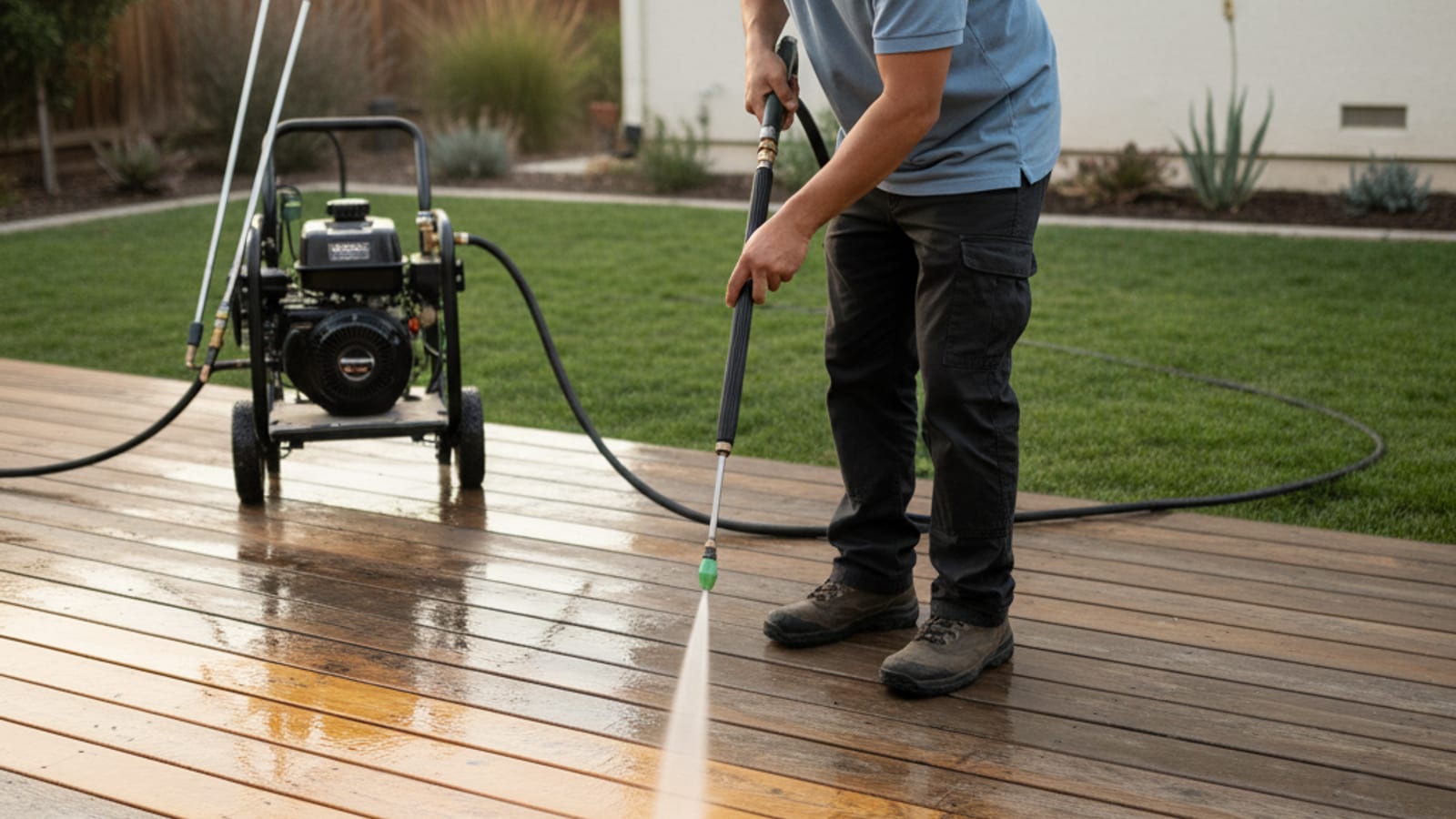
- Use a 25-degree green tip nozzle at 12 to 18 inches from the wood. Never a zero-degree or 15-degree on wood.
- Work with the grain, not across it. Fiber tear-out is the single most common mistake.
- Wait 48 to 72 hours of dry weather before staining. Moisture meter should read under 15%.
- Brighten with an oxalic-acid brightener after cleaning, it neutralizes the high pH left by some detergents and restores color.
- For composite decks (Trex, Fiberon), do not pressure wash. Soft wash only.
- San Diego’s May through October dry stretch is the ideal window, marine-layer moisture in winter makes proper dry time hard.
A deck that’s been sitting through San Diego winters ends up UV-gray, slightly fuzzy from raised grain, and not ready for stain no matter how good the stain is. Prep is 70 percent of the job. A good prep makes a cheap stain look great and last three seasons. A bad prep makes a premium stain peel in one season. Here’s exactly how to pressure wash a deck before staining, what PSI to use, which nozzles, the dry time that matters, and the mistakes that cost a repaint.
This guide covers natural wood (cedar, redwood, pine, ipe). Composite decks (Trex, Fiberon, Azek) need a different method, soft wash only, never pressure, so if that’s what you’ve got, skip the pressure-wash steps and see the composite section at the end.
Timing: when to do this in San Diego
San Diego’s climate gives you a real window for proper deck prep and staining: roughly late April through early November. The marine layer burns off by noon most days, afternoon temperatures stay between 65 and 80, and you get at least 3 dry days in a row most weeks.
Avoid:
- December through March, too much rain risk during cure, too much morning moisture from marine fog
- Full-sun afternoons above 85°F, stain flashes off before penetrating
- The week after a rain event, wood moisture content will still be too high
Ideal schedule:
- Day 1 morning: Pressure wash.
- Day 1 afternoon: Apply wood brightener.
- Days 2 to 4: Dry. Check with a moisture meter.
- Day 4 or 5 morning: Light sand if needed, then stain.
Three dry days minimum. A week is better if the deck is old-growth or heavily weathered.
Tools you actually need
- Pressure washer, 2,000 to 3,000 PSI. Anything more is overkill for wood and risks fiber tear-out.
- 25-degree green tip nozzle. For most deck work.
- 40-degree white tip nozzle. For delicate or thin boards.
- Wand extension. A 24- to 36-inch extension saves your back.
- Stiff-bristle deck brush. For working in cleaners.
- Pump-up sprayer. For applying cleaner and brightener.
- Deck cleaner. Sodium percarbonate (oxygen bleach) works great on wood. Avoid chlorine bleach on cedar, it discolors.
- Wood brightener. Oxalic-acid-based (Behr, Cabot, DeckRevive).
- Moisture meter. $25 at a home center. Reads wood moisture as a percentage.
- Plastic sheeting. To protect siding, plants, and windows.
Step-by-step pressure wash prep
1. Clear the deck
Remove furniture, grills, planters, and rugs. Sweep loose leaves and debris. Check for loose nails or popped screws, fix them now, not after staining.
2. Protect landscaping
Pre-wet all plants within 10 feet. Cover anything delicate with plastic. Move potted plants off the deck entirely.
3. Apply deck cleaner
Mix sodium-percarbonate cleaner per the label (usually 4 oz per gallon of warm water). Apply with a pump-up sprayer. Work it in with a stiff brush. Let dwell 10 to 15 minutes, do not let it dry.
For mildew-heavy sections (shaded areas), a second application after the first dwell is sometimes warranted.
4. Set your pressure and nozzle
- 25-degree green tip for most boards
- 40-degree white tip for aged cedar or anything thin
- Never zero-degree or 15-degree on wood, fiber damage is guaranteed
Test on an inconspicuous board first. You want visible cleaning with no fiber fuzz. If you see fuzzing or wood strands lifting, back off, either more distance from the tip or a wider nozzle.
5. Wash with the grain
Hold the wand 12 to 18 inches from the board. Work along the length of each plank, moving with the grain. Overlap passes about 30 percent. Use smooth, even strokes, stopping mid-plank creates dark spots where the cleaner sat longer.
Don’t work side-to-side across the grain. That’s the single most common DIY mistake and it leaves visible cross-grain marks that show through stain.
6. Rinse
After each section, rinse immediately with clean water from a garden hose before the cleaner dries. Then do a final full rinse of the whole deck after all sections are washed.
7. Apply wood brightener
This step is the one most DIYers skip and most pros insist on. Deck cleaners leave the wood at a high pH, which prevents oil-based stains from penetrating properly. An oxalic-acid brightener neutralizes that pH and restores the wood’s natural color, it’s what takes freshly cleaned gray wood back to a warm honey tone.
Mix brightener per label (usually 4 oz per gallon warm water). Apply with pump-up sprayer. Work in with a stiff brush. Dwell 10 to 15 minutes. Rinse thoroughly.
The color change after brightener is dramatic, a dull gray deck will look sunlit again. If your deck doesn’t change color noticeably, you either didn’t use enough or the cleaner wasn’t strong enough in the first pass.
8. Let it dry
This is where most DIYers rush and pay for it. Before staining, the wood moisture content needs to be under 15%, ideally under 12%. A cheap pin-style moisture meter costs $25 and gives you an accurate reading.
- 48 hours minimum of dry weather
- 72 hours is safer
- 96 hours for dense hardwoods like ipe
- Longer if humidity is above 70% or morning fog is heavy
If you stain wet wood, the stain sits on top instead of penetrating, and it peels in 6 to 10 months. The moisture meter is the only reliable way to know.
Cedar vs pressure-treated vs ipe, different rules
Cedar and redwood are softer than most homeowners realize. 2,000 PSI is the right ceiling. Any more and you’ll see fiber tear-out. After cleaning, both benefit heavily from oxalic-acid brightener.
Pressure-treated pine handles more pressure (up to 2,800 PSI is fine), but the density varies board-to-board. Test each board type.
Ipe and other hardwoods need the gentlest touch, 1,800 PSI with a 40-degree nozzle. Old-growth ipe is dense but brittle at the surface. Stain penetration is also slower, which means longer dry time and careful product selection (use an oil-based penetrating stain, not film-forming).
Composite decks: soft wash only
Trex, Fiberon, Azek, TimberTech, all modern composite brands explicitly void warranty if pressure washed at more than 1,500 PSI. Some prohibit pressure washing entirely.
For composite:
- Sweep thoroughly.
- Apply composite-specific deck cleaner (Corte-Clean, Trex DeckCleaner, or a soft-wash sodium hypochlorite at 1% with surfactant).
- Dwell 10 minutes.
- Scrub with a soft-bristle brush.
- Rinse with garden hose, no pressure washer.
Composite doesn’t need staining. If yours looks dull, a cleaning alone restores it.
Picking the right stain
After prep, stain selection matters almost as much as prep quality. For San Diego’s sun exposure:
- Oil-based penetrating stain (Cabot Australian Timber Oil, Ready Seal, TWP), best for natural wood, 2 to 3 year reapply cycle
- Semi-transparent stain: shows grain, decent UV protection, 2 year cycle
- Solid stain: full coverage, longest lasting, hides grain entirely
- Sealer only (clear), shortest lifespan, typically 12 months in SD sun
UV exposure in San Diego is intense. Any unsealed wood will gray visibly within a year. A properly prepped and stained deck with an oil-based penetrating stain typically goes 2 to 3 years before re-stain is needed.
When to call a pro
Small deck, straightforward access, you’re handy, DIY works. Call a pro when:
- Deck is over 300 square feet
- Multiple levels or stairs
- Old-growth cedar or ipe (unforgiving if you mess up)
- Heavy mildew or sunscreen-staining on north-facing sections
- You want both cleaning and staining done (combined work usually saves money)
Our deck and patio cleaning covers pressure washing with the right PSI and nozzle, detergent plus brightener, and proper dry time monitoring. Most mid-size decks run $250 to $500 for clean-and-prep only; staining is quoted separately based on square footage and product selection.
Ready to book? Call (858) 925-5546 or text deck photos through our contact form. Upfront pricing, serving all of San Diego County. Best time to book a prep job is 5 to 7 days ahead of when you want to stain, that way we handle the weather window for you.