TL;DR
- Asphalt shingle roofs must be cleaned with low-pressure soft wash only. ARMA (Asphalt Roofing Manufacturers Association) specifically says so.
- Pressure washing asphalt shingles voids every major manufacturer’s warranty and removes 10 to 20 years of granule protection.
- The correct chemistry is sodium hypochlorite and water at roughly 3 to 1, plus surfactant. Dwell 10 to 20 minutes, rinse with low pressure.
- Never walk on a wet shingle roof. Never use a ladder on a wet shingle roof. This is a ground-level job from the start.
- DIY is possible on a single-story ranch. Most homeowners shouldn’t attempt it on anything with a steep pitch or multiple stories.
If you’ve got black streaks running down your asphalt shingle roof, that’s gloeocapsa magma: a cyanobacteria that’s surprisingly common along the San Diego coast thanks to marine-layer humidity. The streaks aren’t dirt, and they aren’t going to come off with a hose. They’re also not going to come off with a pressure washer without damaging the roof so badly that you’ll need a new one inside a decade. The only safe method for cleaning roof shingles is a low-pressure soft wash, and it needs to be done right. Here’s exactly how.
Why pressure washing a roof is a mistake
Asphalt shingles have three layers that matter: the fiberglass mat, the asphalt coating, and the ceramic-coated granules on top. Those granules do three jobs. They protect the asphalt from UV (which makes the shingle brittle), they shed water, and they’re the only thing between your house and a leak.
A pressure washer at 3,000 PSI blasts those granules off. A medium-duty cleaning removes 5 to 10 years of granule protection. A heavy cleaning removes 15 to 20. You’ll see the granules in the gutter afterward, a fine gravel layer that should have been on the roof for the next two decades.
Manufacturer guidance is unambiguous. GAF, Owens Corning, CertainTeed, and every other major asphalt shingle maker either outright prohibit pressure washing or void the warranty if used. ARMA, the Asphalt Roofing Manufacturers Association, recommends “a solution of water and sodium hypochlorite applied at low pressure”, that’s soft washing. The specific recommendation is in their Technical Bulletin on algae discoloration. No blasting. No walking. No brushes.
The same rule applies to concrete and clay tile roofs, for a different reason, walking on them cracks tiles, and high pressure strips the sealer coat.
What soft washing a roof looks like
A proper residential roof soft wash has four steps:
- Pre-wet the roof and all surrounding landscaping with plain water.
- Apply a sodium-hypochlorite-and-surfactant mix at around 3% to 4% final strength (stronger than house-wash chemistry because the algae load is heavier and dwell has to last longer against dripping).
- Dwell 10 to 20 minutes. The streaks will lighten visibly during dwell.
- Rinse with plain water at low pressure, a garden hose, not a pressure washer.
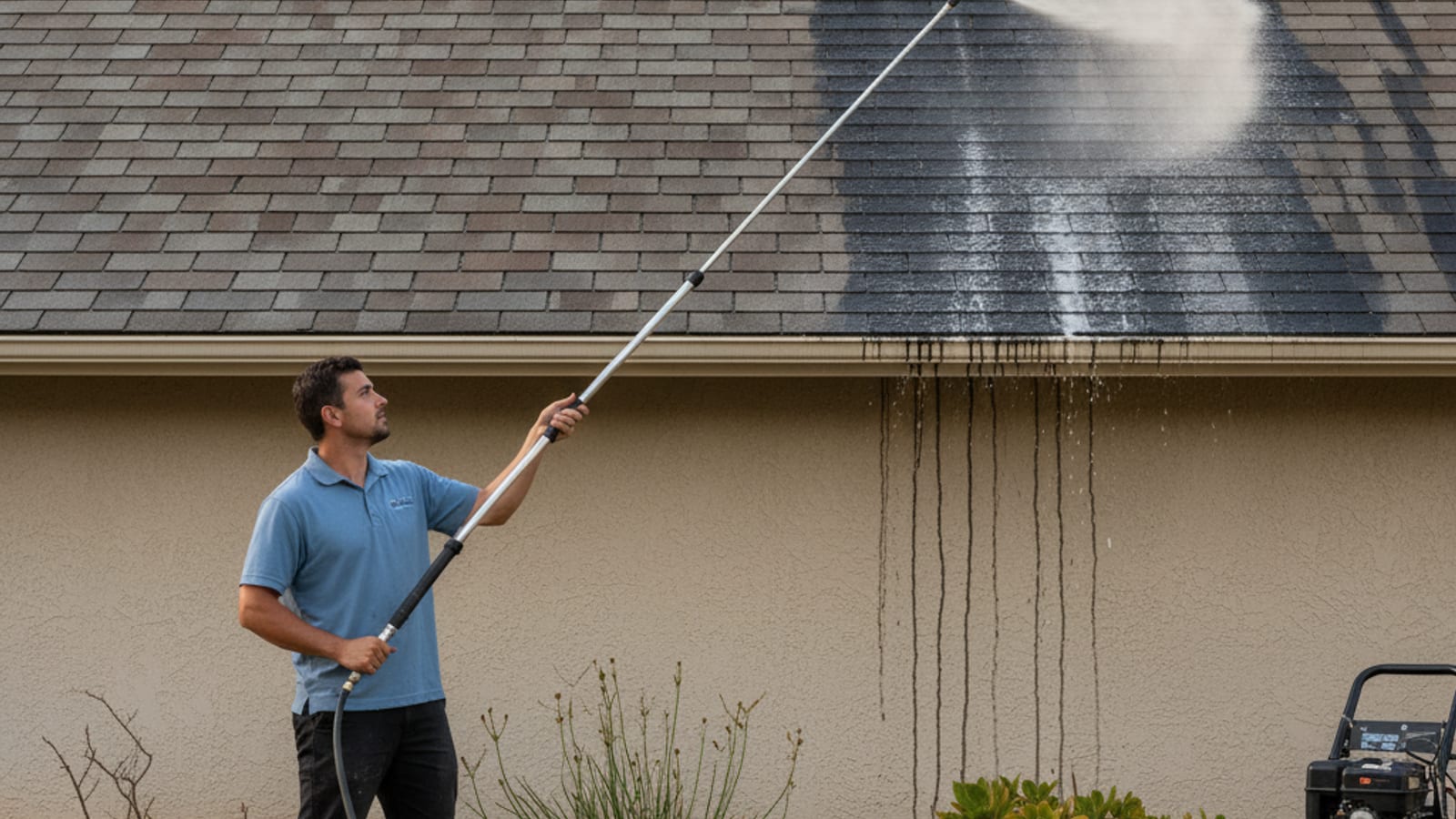
All of this happens from the ground. A pro uses an 18-to-28-foot telescoping soft-wash wand and a 12-volt pump. A DIYer on a single-story ranch can do it with a pump-up sprayer and a long extension wand if the pitch is low. Anything steeper than a 6:12 pitch, or anything over single-story, should be a pro job. Not because the chemistry is harder but because the logistics are.
The chemistry, specifically
The recipe most pros use for asphalt shingle roofs is:
- 1 gallon 12.5% sodium hypochlorite (pool shock)
- 2 gallons water
- 3 oz quality surfactant (Southeast Softwash or Pressure-Tek branded, not dish soap)
That’s about a 4% sodium hypochlorite solution. Stronger than house-wash chemistry by design, a roof is horizontal enough that gravity pulls the mix off quickly, so it has to be potent enough to kill algae during a shorter effective contact time.
For tile roofs, concrete or clay, use a gentler mix, around 2% to 3%, because tile is more delicate to staining if over-concentrated bleach streaks down the surface.
Never mix chlorine-based cleaners with any acid or ammonia. Never store pre-mixed solutions in metal containers. Wear safety glasses and long sleeves, sodium hypochlorite at this strength will burn skin if splashed.
Prep that matters more than you think
Landscaping
Everything within 15 feet of the roof drip line needs to be pre-wet. That includes lawn, shrubs, hydrangeas, azaleas, ferns, succulents. San Diego drought-tolerant landscaping is actually more sensitive to bleach than traditional lawn turf, the cactus and agave leaves show burn immediately.
Pre-wet thoroughly. Mist again during dwell. Rinse heavily after the roof rinse.
Gutters
Clear the gutters first, otherwise chemistry pools inside and sits on painted metal for hours. If the gutters have leaves and debris in them, do a gutter clean-out first, then the roof.
Windows
Cover with plastic if they’re painted-frame or older single-pane. Modern vinyl-frame windows handle the brief contact fine but still look streaky afterward if the runoff sits.
Neighbors
Let the next-door neighbor know. Chemistry drift onto their car is a conversation nobody wants.
Weather
Dry day. Overcast or morning cool. No rain forecast within 4 hours of the rinse (rain during dwell would dilute the chemistry before it works; rain right after the rinse is fine). Wind under 10 mph, drift becomes a real problem above that.
The step-by-step
1. Gear up
Safety glasses. Nitrile or rubber gloves. Long sleeves. Old shoes you don’t mind getting bleach-spotted. A hat for sun.
2. Pre-wet everything
Roof, walls below the drip line, gutters, and all landscaping within 15 feet. A full 10-to-15 minute soak with the garden hose.
3. Apply chemistry from the ground
Using a pump-up sprayer with a long fan-tip wand (or a pro telescoping wand), apply the soft-wash solution evenly across the roof. Start at the lowest edge and work up in bands. Don’t saturate, you want the surface visibly wet with mix, not pooling.
For single-story ranch roofs, a 2-gallon pump-up sprayer will cover about 600 square feet. Anything larger, refill and continue.
4. Dwell 10 to 20 minutes
Watch the streaks fade. That’s the algae dying. If the chemistry starts to dry (you’ll see a chalky film), mist with clean water or reapply lightly.
Under no circumstances walk on the wet shingles during dwell. They’re slick and soft when wet. This is a ground-level observation step.
5. Rinse with a garden hose
Plain water at normal hose pressure, top-down. Rinse each section for 30 to 60 seconds until runoff runs clear. Rinse the gutters. Rinse the walls below the drip line. Rinse the landscaping heavily.
A garden hose without a nozzle produces about 40 PSI, roughly what the soft-wash pump produces, which is plenty. Don’t use a pressure washer for rinse. Plain flow is what’s needed.
6. Clean up
Flush the pump-up sprayer with plain water. Rinse your gear. Walk the perimeter checking for chemistry pooling anywhere it shouldn’t, a clogged downspout, a flat patch of decking, a concrete drive.
What not to do
Never walk on a wet shingle roof. They’re slick. Falls are serious. Even professionals don’t walk on a wet roof mid-wash.
Never use a pressure washer on asphalt shingles. See the first section.
Never use a stiff brush. Bristles strip granules almost as fast as pressure does.
Never mix in oxalic acid or any acid product. Plus bleach equals chlorine gas.
Never soft wash in direct hot sun. The chemistry evaporates before it works. Morning fog or afternoon shade are ideal San Diego timing.
Never skip the landscaping pre-wet. It’s the single most avoidable cause of plant damage on soft-wash jobs.
When to call a pro
For most homeowners, cleaning a roof themselves is in the “technically possible, rarely worth it” column. The math usually works out like this:
- Single-story ranch, low pitch: DIY is feasible with a pump-up sprayer and a 12-foot wand. Time: 4 to 6 hours. Cost of supplies: about $80.
- Single-story with multiple pitches or one high peak: Pro job.
- Two-story or custom: Always a pro job.
- Clay or concrete tile roof: Pro job, tile is fragile and needs tile-specific chemistry.
A professional roof cleaning service uses 12V soft-wash equipment, roof-specific chemistry strength, 24-foot wands for reach, and follows ARMA guidance to the letter. Most San Diego asphalt roofs run $400 to $900 depending on size and pitch. The streaking typically stays gone for 3 to 5 years, so it prices out to $100 to $180 per year of clean roof.
We also handle the related work that often comes up alongside a roof cleaning, soft-washed siding (house washing) and gutter exterior cleaning, so you can book one visit that handles everything.
Ready for a quote? Call (858) 925-5546 or send us a roof photo through our contact form. Upfront pricing, serving all of San Diego County from Oceanside to Chula Vista.